
Areola Color Restoration After Mastectomy — Nipple Tattoo Timing
Nipple tattoo after mastectomy is a step many patients call the moment reconstruction finally feels complete. Dr. Cecilia Rusnak’s Areola Color Restoration — which includes 3D areola tattoo technique — is timed in coordination with your reconstruction surgeon, typically four to six months after final surgery. This guide covers how nipple tattoo timing works and what your surgical team confirms before clearing you.
If you’re a breast cancer survivor approaching the end of your reconstruction journey, the question of 3d areola timing after mastectomy is one of the last meaningful decisions you’ll make about your physical recovery. Get it right and you complete a long, hard journey with a result that genuinely feels complete. Get it wrong — by treating too early — and the scar tissue that was still remodeling produces uneven color results that may need correction later.
At Healing Skin Medical Aesthetics, 3D areola restoration is performed by Dr. Cecilia Rusnak PhD, LME, DAc, with three decades of clinical experience. The most important thing we tell patients about timing: the right answer depends on your specific reconstruction history, and the conversation should involve your reconstructive surgeon, not just your paramedical tattoo practitioner.
Important: This article is general information for patients researching their options. It is not medical advice and does not substitute for guidance from your own reconstructive surgeon. Coordinate timing decisions with your surgical team.
Why You Should Coordinate 3D Areola Tattoo Timing With Your Surgeon
Understanding 3d areola timing after mastectomy starts with how reconstructed tissue heals. Reconstructed tissue follows a predictable healing arc. Early after surgery, the tissue is actively remodeling: collagen is laying down, blood vessels are reorganizing, and the skin’s pigmentation is shifting as inflammatory healing settles. During this window, any pigment introduced by tattoo work will heal unpredictably — the very same pigment that produces a natural-looking result on stable tissue can shift dramatically on actively healing tissue.
The window for stable, predictable 3d areola timing after mastectomy work generally opens once tissue has reached its long-term color and texture and stopped actively remodeling. For most patients, this is somewhere between 6 and 12 months after the final reconstructive procedure. The exact timing depends on what surgeries you’ve had and how your body has healed.
The Surgical Reconstruction Sequence That Affects Timing
Reconstruction is rarely a single surgery, and 3d areola timing after mastectomy depends on which step of the reconstruction sequence you’re at. Most breast cancer survivors go through a sequence of procedures, and the right 3d areola timing after mastectomy depends on where you are in that sequence.
Step 1: Mastectomy
The mastectomy itself, often combined with immediate placement of tissue expanders or implants. Healing time before next steps is typically 6 to 12 weeks but varies.
Step 2: Implant Exchange or Final Reconstruction
If tissue expanders were used, they’re exchanged for permanent implants. Patients undergoing autologous (flap) reconstruction complete the major reconstructive procedure here. Healing time before next steps is typically 3 to 6 months.
Step 3: Revision Surgeries
Many patients have one or more revision procedures to refine shape, symmetry, fat grafting, scar revision, or other adjustments. Each revision restarts a healing window for the affected area.
Step 4: Optional Nipple Reconstruction
Some patients have surgical nipple reconstruction (creating a raised nipple from existing tissue or graft). Others skip this step and go directly to 3D areola tattoo work, which can create the visual appearance of a dimensional areola without surgical nipple reconstruction. If nipple reconstruction was done, healing time before tattoo work is typically 3 to 6 months.
Step 5: 3D Areola Tattoo
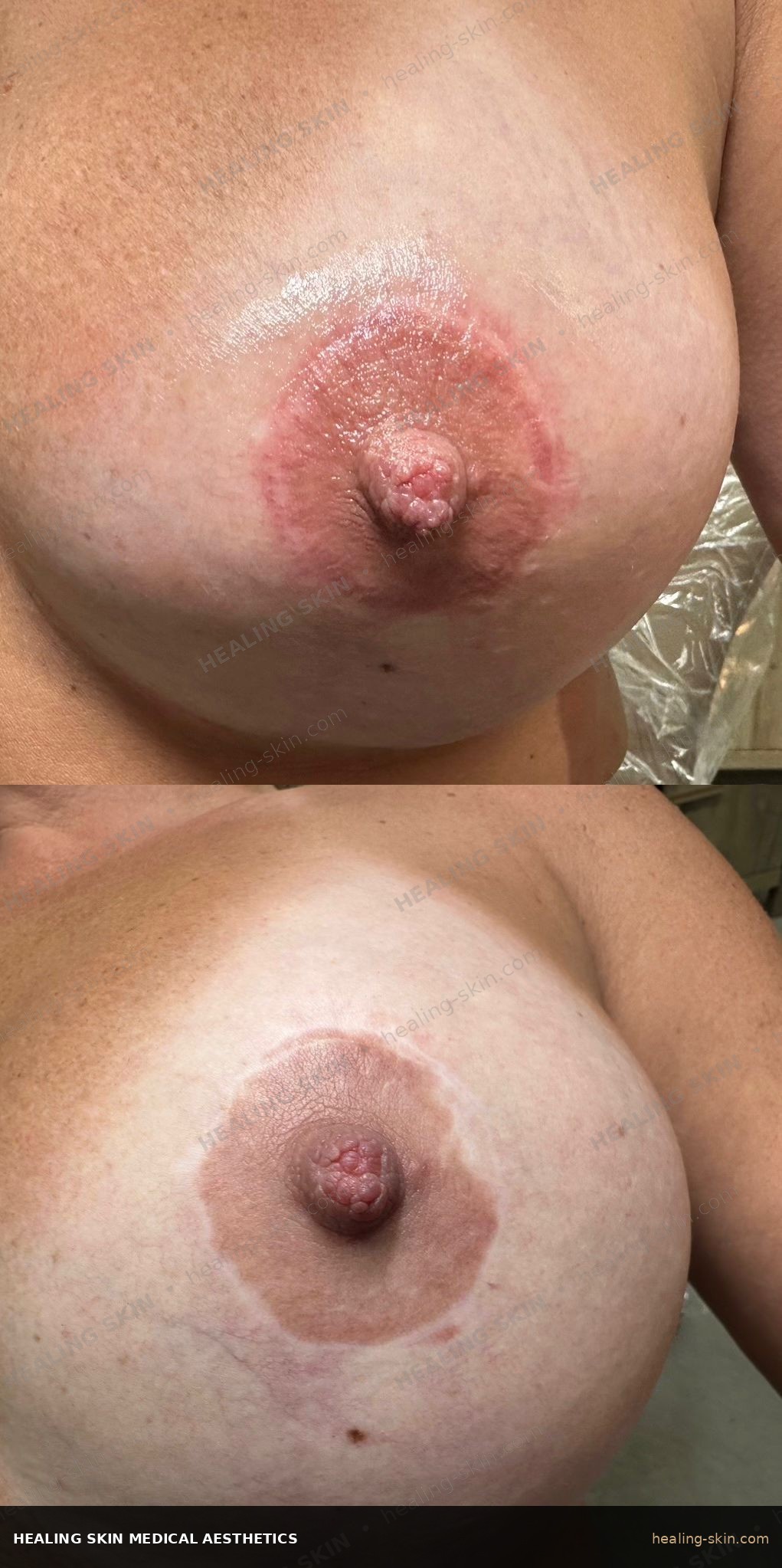
The final visual step. This is where most patients arrive after the rest of the journey is complete. The clinical goal is to perform tattoo work on tissue that is fully healed, stable in color and texture, and not currently undergoing additional reconstructive procedures.
How to Coordinate 3D Areola Tattoo Timing: 5 Factors That Matter
There is no universal date for 3d areola timing after mastectomy that works for everyone. Decisions should be informed by these specific factors:
Time Since Final Reconstructive Procedure
Wait at least 3 months after final reconstructive surgery, with 6 to 12 months being the typical sweet spot. If your surgeon hasn’t explicitly cleared you, ask. Most surgeons are happy to give a specific clearance date once they’ve evaluated your healing.
Whether You’ve Completed Active Cancer Treatment
Wait until you’ve completed active chemotherapy and radiation. Both treatments can affect skin healing in ways that complicate tattoo work. Most oncologists clear patients for paramedical tattoo work several months after the final treatment cycle, but this varies by individual case.
Your Body’s Healing Pattern
Some patients heal faster, some slower. If you’ve had complications in earlier reconstruction phases — delayed wound healing, infections, capsular contracture — your reconstructive surgeon may recommend a longer healing window before tattoo work. Trust their judgment on this; it’s based on having watched your specific tissue heal.
Whether You’re Planning Additional Reconstructive Procedures
If you’re planning fat grafting, capsulectomy, or any procedure that will affect the skin where the tattoo will be placed, complete those procedures first. Tattoo work performed before additional surgery often needs to be redone after surgery, which is both costly and frustrating.
Your Emotional Readiness
This part is rarely discussed but it’s real. Some patients feel ready for the final step at the earliest possible date; others want more time to settle emotionally with their reconstructed body before adding the visual completion piece. Both responses are completely normal. There is no single right timeline — only the right timeline for you.
How to Coordinate 3D Areola Tattoo Timing in the Conversation With Your Surgeon
If your reconstructive surgeon hasn’t proactively raised 3d areola timing after mastectomy, raise it yourself at your next appointment. Specific questions worth asking:
- Am I cleared for paramedical tattoo work, or is there a healing window I should still observe?
- Are there any specific concerns with my reconstruction that affect tattoo timing or technique?
- Are there any planned additional procedures that should happen before tattoo work?
- Do you have specific paramedical practitioners you’ve worked with before that you’d recommend?
- Is there anything about my skin or healing pattern I should share with the tattoo practitioner?
- Would you be willing to communicate directly with the practitioner if questions come up?
Most reconstructive surgeons are familiar with paramedical tattoo work and have opinions about timing and technique. Some have preferred practitioners they refer to; others are open to whoever you choose. Either way, having the conversation puts your surgeon in the loop, which protects both your reconstruction outcome and your tattoo result.
How Healing Skin Helps You Coordinate 3D Areola Tattoo Timing With Reconstructive Surgeons
Dr. Rusnak coordinates 3d areola timing after mastectomy with reconstructive surgeons across the Orlando area and beyond when patients request it. Coordination typically involves:
- Reviewing your reconstruction history with you during the free video consultation
- Confirming surgical clearance before scheduling in-person sessions
- Communicating directly with your surgeon’s office on timing or technique questions when needed
- Adjusting treatment timing to align with your surgeon’s recommendations rather than overriding them
- Sharing post-treatment results with your reconstructive surgeon if you’d like them in the loop
For an authoritative reference on the broader reconstruction timeline, the American Society of Plastic Surgeons publishes patient resources on reconstruction phases that can supplement your conversations with your own surgeon.
Frequently Asked Questions About 3D Areola Timing After Mastectomy
How long after mastectomy can I get 3D areola tattoo work — what’s the right 3d areola timing after mastectomy?
The general guideline for 3d areola timing after mastectomy is 6 to 12 months after your final reconstructive procedure, with a minimum of 3 months. Specific timing depends on what surgeries you’ve had, how you’ve healed, and whether you have any planned additional reconstructive work. Always coordinate with your reconstructive surgeon — most are happy to give a specific clearance date based on your individual case.
Can I get 3D areola tattoo work before nipple reconstruction surgery?
Yes. Some patients skip surgical nipple reconstruction entirely and go directly to 3D areola tattoo work, which uses careful color shading and 3D dimension techniques to create the visual appearance of a dimensional areola on a flat reconstructed surface. Other patients have surgical nipple reconstruction first and then add 3D areola color work afterward. Both paths are valid; the choice is yours.
What if I’m still in active cancer treatment?
We do not perform 3D areola tattoo work during active chemotherapy or radiation. Both treatments affect skin healing in ways that complicate tattoo outcomes. Most oncologists clear patients for paramedical tattoo work several months after the final treatment cycle, but this varies by individual case. Coordinate with your oncologist before scheduling tattoo work.
Can the timing be too late?
Generally no. We see patients 5, 10, even 20 years post-mastectomy with excellent results. The tissue is stable and predictable at that point. The ‘too early’ problem is much more common than ‘too late’ — patients sometimes feel pressure to complete the journey quickly and end up treating before their tissue has fully stabilized. There is no expiration date on this step.
Will my insurance cover 3D areola work if I time it correctly?
Many post-mastectomy 3D areola cases qualify for insurance coverage under the Women’s Health and Cancer Rights Act of 1998 regardless of timing. Coverage depends on your specific insurer, plan, and whether the procedure is documented as part of your reconstructive plan. Dr. Rusnak’s office prepares medical necessity documentation with appropriate CPT codes for qualifying patients. Pre-authorization is recommended.
How do I know if my body is ready for 3D areola work?
Three signs that suggest readiness: your reconstructed tissue color has been stable for at least 3 months, you’re not planning additional reconstructive surgeries that affect the same area, and your reconstructive surgeon has cleared you. Beyond those clinical markers, emotional readiness matters too — there is no clinical penalty for waiting until you feel ready.
What happens if I get 3D areola work too early?
Treatment performed on actively remodeling tissue can produce unpredictable color results: pigment shifts, uneven coverage, premature fading, or color that simply doesn’t match the surrounding tissue once the tissue settles. Correction is typically possible but adds cost and time. The 12-month minimum rule that experienced paramedical practitioners follow is specifically designed to prevent these outcomes.
Can I still pursue 3D areola work if my reconstruction was years ago?
Yes, absolutely. Many of our patients come to us 5 to 20 years after their reconstruction, sometimes after years of considering and deferring the decision. Older reconstructions are often actually easier to treat because the tissue is fully stable and predictable. There is no expiration date on this step. Whenever you’re ready is the right time.
Looking for the scheduling-window specifics? Read the companion piece: 3D Areola Tattoo Timing After Mastectomy: When to Schedule Treatment →
If you’re ready to coordinate 3D areola tattoo timing with your reconstruction team, our clinical workflow makes the conversation simple.
Ready to Discuss Your Timing?
Every reconstruction is different and 3d areola timing after mastectomy is highly individual, and the right 3d areola timing after mastectomy depends on your specific surgical history. The best place to start is a free video consultation with Dr. Rusnak where she can review your situation, discuss timing in coordination with your reconstructive surgeon’s guidance, and answer questions specific to your case.
Schedule your free video consultation by calling (689) 288-8011 or book online. To explore financing options before your call, you can apply in under two minutes through Cherry, Klarna, or Affirm without affecting your credit score.
For more on the 3D areola restoration process specifically, see our 3D areola tattoo Orlando guide, our 3D areola service page, and our before and after gallery. Aftercare during the healing window uses Dr. Rusnak Wellness products formulated specifically for paramedical tattoo healing.