
Advanced ISR Inkless Scar Revision: How Serum-Based Treatment Is Changing the Way We Heal Scars and Stretch Marks
The science, the process, and the clinical results behind inkless revision — and why it may be the first step before any pigment-based camouflage
By Dr. Cecilia Rusnak, LME, AP, DAc | Master Trainer, Healing Skin Medical Aesthetics
Published 2026 | healing-skin.com/blog
▼ IMAGE: Featured image — ISR treatment in progress or before/after. Alt text: “Advanced ISR inkless scar revision treatment showing serum-based microneedling technique on stretch marks at Healing Skin Medical Aesthetics” ▼
Advanced ISR inkless scar revision is one of the most significant developments in paramedical skin treatment in the past decade. Unlike ink-based scar camouflage, which deposits pigment into the skin to visually blend a scar with the surrounding tissue, ISR takes a fundamentally different approach: it triggers the body’s own healing response to regenerate collagen, elastin, and natural melanin production without introducing any foreign pigment at all.
For clients with stretch marks, surgical scars, or hypopigmented skin, advanced ISR inkless scar revision offers a path to improvement that many have been told does not exist. And for paramedical tattoo practitioners, understanding when to use ISR versus ink-based camouflage — and how to combine both — is what separates a competent artist from a truly clinical practitioner.
This guide covers the science behind ISR, how the procedure works step by step, who is a candidate, how it compares to traditional scar treatments, and why it has become a cornerstone of the clinical approach at Healing Skin Medical Aesthetics.
The Science Behind ISR: How Inkless Revision Actually Works
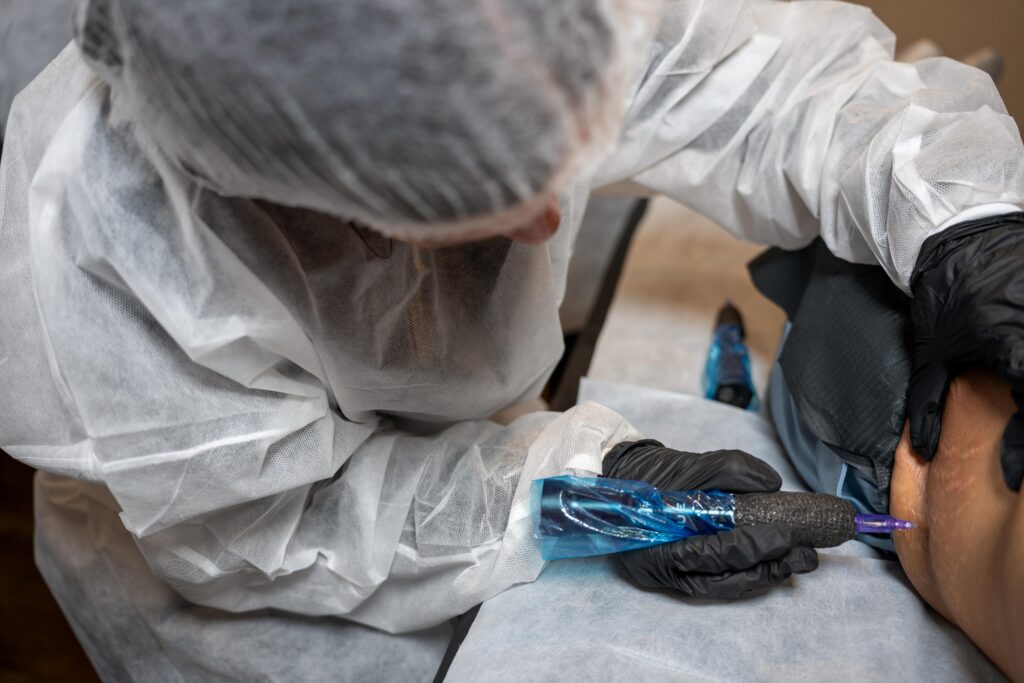
The advanced ISR inkless scar revision technique uses a professional rotary tattoo machine fitted with fine needle cartridges — the same equipment used in ink-based paramedical tattooing — but instead of depositing pigment, the practitioner infuses a medical-grade healing serum into the dermis. This serum typically contains a combination of hyaluronic acid, stem cell growth factors, peptides, amino acids, and vitamins specifically formulated to promote tissue repair.
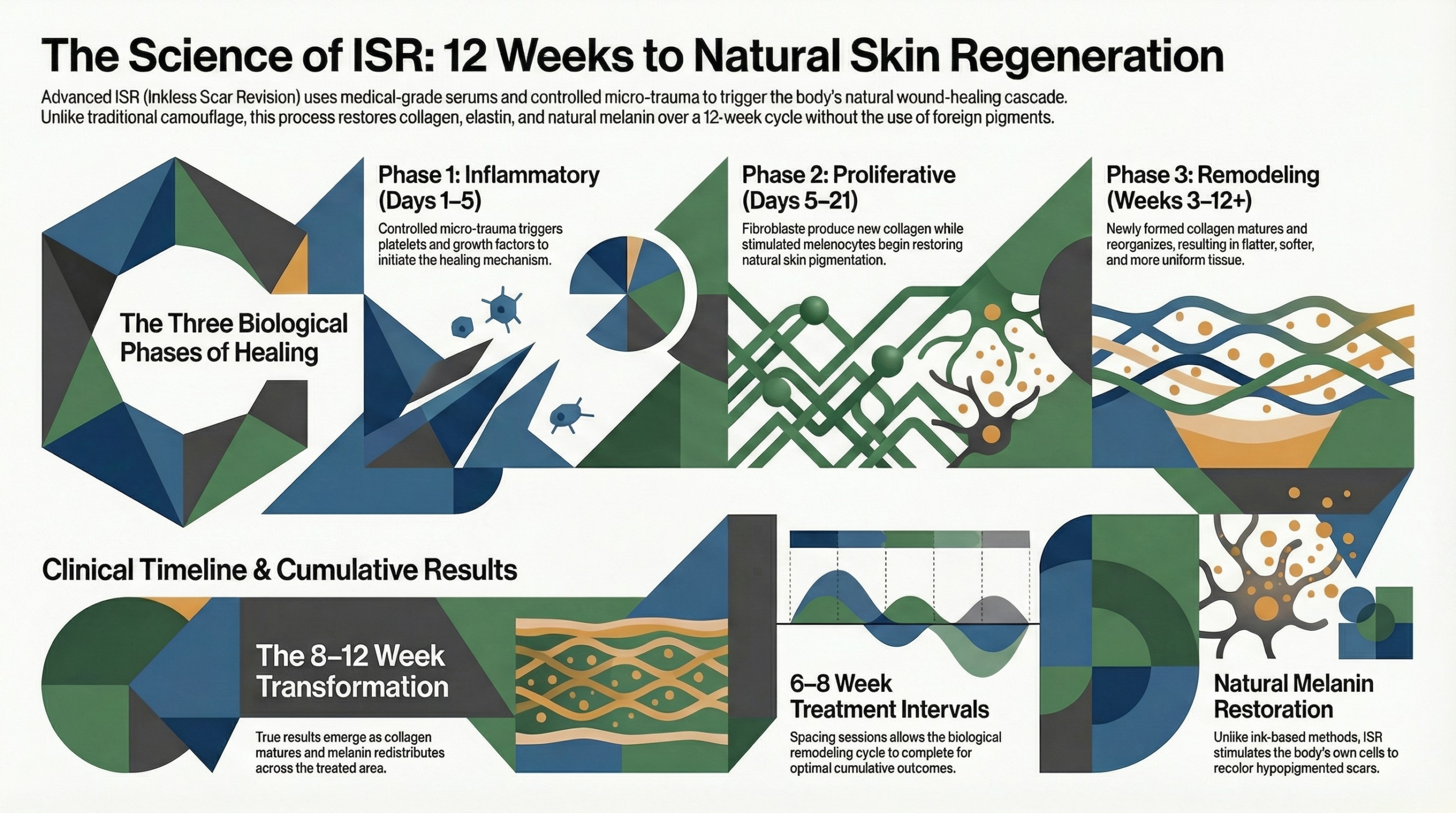
The controlled micro-trauma created by the needles triggers the body’s natural wound-healing cascade. This cascade has three distinct phases that are critical to understanding why ISR works:
Inflammatory phase (days 1–5).
The body responds to the micro-injuries by sending platelets, white blood cells, and growth factors to the treatment area. This is why the skin appears red and slightly swollen immediately after treatment. The inflammatory response is not a side effect — it is the mechanism that initiates healing.
Proliferative phase (days 5–21).
New collagen and elastin fibers begin forming in the treatment area. Fibroblasts migrate to the wound sites and start producing the structural proteins that give skin its strength and elasticity. Melanocytes — the cells that produce melanin — are also stimulated, which is why ISR can restore natural pigmentation to hypopigmented (white or silver) scars and stretch marks without any external pigment being added.
Remodeling phase (weeks 3–12+).
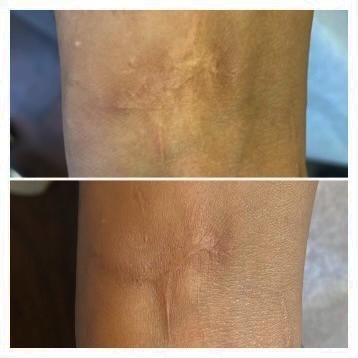
The newly formed collagen matures and reorganizes, improving both the texture and the color of the treated area. Scar tissue becomes flatter, softer, and more uniform. Stretch marks narrow and blend more naturally with the surrounding skin. This phase continues for months after treatment, which is why results improve progressively over 8–12 weeks and why multiple sessions spaced 6–8 weeks apart produce the best cumulative outcomes.
The role of collagen remodeling in wound healing has been extensively documented in dermatologic research. The National Institutes of Health provides a comprehensive overview of the wound healing phases that underpin the ISR mechanism, confirming that controlled micro-trauma stimulates predictable collagen synthesis and tissue regeneration.
ISR vs Traditional Scar Treatments: How Inkless Revision Compares
Clients exploring advanced ISR inkless scar revision have usually already researched — or tried — other scar treatment methods. Here is how ISR compares to the most common alternatives:
ISR vs laser scar treatment.
Laser treatments use focused light energy to ablate (remove) or resurface the top layer of skin, stimulating collagen production through thermal injury. While effective for certain scar types, laser carries a significant risk of post-inflammatory hyperpigmentation on darker skin tones (Fitzpatrick IV–VI), requires multiple sessions at $200–$1,000+ per session, involves meaningful downtime, and cannot restore melanin production to hypopigmented scars. ISR achieves collagen stimulation without thermal damage, is safer across all Fitzpatrick types, and actively promotes melanin regeneration — something no laser can do.
ISR vs surgical scar revision.
Surgical revision physically excises scar tissue and re-closes the wound with the goal of producing a thinner, less visible scar. This is appropriate for severely raised or contracture scars but creates a new wound that must heal — and can itself scar. Surgical revision also cannot address stretch marks or widespread hypopigmentation. ISR is non-surgical, non-ablative, and requires no incisions, stitches, or wound care beyond topical aftercare.
ISR vs microneedling.
Standard microneedling uses a pen device with short, uniform needles to create superficial punctures across the skin surface. It is effective for general skin rejuvenation and mild texture improvement but does not penetrate deeply enough to break up dense scar tissue or stimulate melanocyte activity in deeper dermal layers. ISR uses a rotary tattoo machine with longer, more precise needle cartridges that reach the dermis at a controlled depth, combined with medical-grade serums that are deposited into the treatment area rather than simply applied topically. The clinical outcomes for scar and stretch mark revision are substantially superior to standard microneedling.
ISR vs ink-based scar camouflage.
Ink-based scar camouflage deposits custom-matched pigment into the scar to visually blend it with the surrounding skin. This is the gold standard for mature, flat, hypopigmented scars that have stabilized in color. However, camouflage does not change the texture of the scar, does not stimulate collagen production, and introduces foreign pigment that must be carefully matched and may require touch-ups as the pigment fades over time. ISR addresses texture, depth, and color from within — without any foreign substance remaining in the skin permanently. For many clients, the optimal approach is ISR first (to improve texture and stimulate natural pigmentation), followed by ink-based camouflage as a finishing step if needed.
Who Is a Candidate for Advanced ISR Inkless Scar Revision?
The advanced ISR inkless scar revision procedure is appropriate for a wide range of clients and scar types. The best candidates include:
- Clients with white or silver stretch marks on the abdomen, hips, thighs, breasts, or arms
- Clients with hypopigmented (lighter than surrounding skin) surgical scars that are flat and mature
- Clients with tummy tuck, C-section, breast lift, or liposuction scars
- Clients with burn scars or trauma scars that have stabilized in color and texture
- Clients with Fitzpatrick IV–VI skin who carry elevated PIH risk with ink-based procedures
- Clients who prefer a natural, non-pigment approach to scar improvement
- Clients preparing for ink-based camouflage who need texture improvement first
ISR is NOT appropriate for:
- Scars that are still pink, red, or actively changing (must be at least 9–12 months old)
- Keloid or actively hypertrophic scars (medical scar revision needed first)
- Clients currently on isotretinoin (Accutane) or blood-thinning medications
- Clients who are pregnant or breastfeeding
- Active skin infections, eczema, or psoriasis in the treatment area
A thorough consultation is essential before treatment begins. At Healing Skin Medical Aesthetics, every ISR case starts with a clinical skin assessment, Fitzpatrick typing, scar maturity evaluation, and for darker skin types, a patch test. Schedule a consultation to discuss whether ISR is the right approach for your specific case.
What to Expect During and After an ISR Treatment Session
Understanding the treatment process helps clients prepare mentally and physically for the best possible outcome.
Before treatment.
Avoid sun exposure, retinoids, and exfoliating acids on the treatment area for one week prior. Arrive with clean skin free of lotions, oils, or makeup. A topical numbing agent is applied to the treatment area 20–30 minutes before the procedure begins.
During treatment.
The practitioner uses a rotary tattoo machine with fine needle cartridges to work the medical-grade serum into the scar tissue in controlled, even passes. The sensation is comparable to light scratching — most clients rate discomfort at 2–4 out of 10 with numbing. Session length varies from 30 minutes to 2 hours depending on the treatment area. The practitioner controls needle depth, speed, and the number of passes based on the scar type, skin thickness, and Fitzpatrick classification. For an advanced ISR inkless scar revision treatment on darker skin types, fewer passes at a shallower depth are used to minimize PIH risk while still achieving therapeutic micro-trauma.
Immediately after treatment.
The treated area will appear red, swollen, and raised — similar to a moderate sunburn. This is the expected inflammatory response and indicates the healing cascade has been activated. The swelling typically subsides within 24–48 hours. Redness may persist for 3–7 days.
Healing timeline.
Days 1–7: redness, mild swelling, tightness. Days 7–14: dryness, light flaking, possible itching as collagen production accelerates. Weeks 2–4: the treated area transitions through a brown phase (darker skin types may see this more prominently). Weeks 4–12: the true result emerges as collagen matures and melanin redistributes. Results continue improving for up to 6 months after the final session.
Aftercare.
Keep the area clean with gentle, fragrance-free cleanser. Apply the recommended healing serum or aftercare products as directed. Avoid sun exposure on the treated area — SPF 50+ is essential. Avoid swimming, saunas, and excessive sweating for 7–10 days. No retinoids, glycolic acid, or exfoliating products until fully healed. The Dr. Rusnak Wellness skincare line includes vegan, paraben-free formulations specifically designed to support post-procedure healing and are used in our clinical aftercare protocols.
How Many Sessions Does ISR Require?
The number of sessions varies based on the type, severity, and age of the scar or stretch marks being treated, as well as the client’s Fitzpatrick skin type and healing response.
- Mild stretch marks or thin surgical scars: 1–2 sessions may produce significant improvement
- Moderate stretch marks or larger scars: 2–3 sessions are typical for optimal results
- Severe or widespread stretch marks: 3–4 sessions with gradual cumulative improvement
- Fitzpatrick IV–VI clients: May require fewer, gentler sessions with longer intervals (8–12 weeks) to allow melanin response to stabilize
Sessions are spaced 6–8 weeks apart to allow the collagen remodeling cycle to complete before adding additional stimulation. Rushing the interval between sessions does not improve results and can increase the risk of over-treatment.
For clients who achieve significant improvement with ISR but want additional refinement, ink-based camouflage can be applied after the final ISR session has fully healed — typically 8–12 weeks after the last treatment. This combined approach produces the most natural, comprehensive results.
The ISR and Camouflage Combined Protocol: When Both Are Needed
One of the most powerful treatment strategies at Healing Skin Medical Aesthetics is the combined ISR and camouflage protocol. This approach uses advanced ISR inkless scar revision as a first phase to improve scar texture, stimulate natural melanin production, and prepare the tissue for pigment application. Once the skin has responded to ISR and the tissue is stable, ink-based stretch mark camouflage or scar camouflage is applied in controlled layers to refine the color match.
This protocol is particularly effective for:
- Stretch marks on dark skin where ink-based camouflage alone carries PIH risk
- Scars with significant texture irregularity that would not hold pigment evenly
- Clients who want the most natural result possible — ISR restores from within, camouflage refines from the surface
- Large treatment areas where achieving a uniform ink color match in a single step would be difficult
The combined protocol typically involves 2–3 ISR sessions followed by 1–2 camouflage sessions, for a total treatment timeline of 4–8 months. The result is a scar or stretch mark that is improved in texture, color, and visibility from multiple biological mechanisms working together.
Why Practitioner Training Matters for ISR
ISR is not standard microneedling. The equipment, needle depth, serum formulation, and technique are all specific to paramedical tattooing, and the clinical decision-making required — when to use ISR alone, when to combine it with camouflage, how to adjust for Fitzpatrick type, how to manage the healing response — requires specialized training.
At Dr. Rusnak Academy, the 3-Day Paramedical Tattoo Certification includes dedicated ISR training as one of three certifications: Advanced ISR Inkless, Stretch Mark Camouflage, and Scar Camouflage. Students learn ISR technique on live models with real stretch marks and scar tissue, practice on diverse Fitzpatrick types, and receive the professional NUE Conceal kit that includes the medical-grade serums used in ISR procedures. The certification also covers the combined ISR-camouflage protocol, giving graduates the clinical versatility to treat any client who walks through their door.
If you are a practitioner interested in adding ISR to your service menu, explore the full Paramedical Tattoo Certification program or the 3D Areola Masterclass for areola-specific advanced training.
Take the Next Step: ISR at Healing Skin Medical Aesthetics
Whether you are a client exploring non-pigment options for your scars or stretch marks, or a practitioner ready to expand your clinical capabilities, advanced ISR inkless scar revision represents the future of restorative skin treatment. It works with the body rather than against it, produces permanent results without foreign pigment, and opens treatment pathways for clients who were previously told nothing could be done.
At Healing Skin Medical Aesthetics in Orlando, Florida, ISR is a core specialty performed by Dr. Cecilia Rusnak and her clinical team. Every treatment is individualized based on clinical assessment, Fitzpatrick classification, and the specific goals of the client.
Ready to explore ISR? Schedule your consultation to discuss whether inkless revision, ink-based camouflage, or a combined protocol is the right approach for your skin.
ABOUT THE AUTHOR
Dr. Cecilia Rusnak, LME, AP, DAc is the founder of Healing Skin Medical Aesthetics and Master Trainer at Dr. Rusnak Academy. She is also a state-licensed Acupuncture Physician and the owner of AcuMedGroup Wellness Center, and the creator of the Dr. Rusnak Wellness skincare line. With over 30 years of clinical experience in integrative medicine and paramedical aesthetics, Dr. Rusnak has trained practitioners nationwide in advanced ISR inkless scar revision, ink-based scar camouflage, stretch mark revision, and 3D areola tattooing.
DISCLAIMER
This article is for educational purposes only and does not constitute medical advice. Treatment outcomes vary based on individual skin type, scar maturity, medical history, and practitioner skill. Always consult with a qualified practitioner for a clinical assessment before undergoing any paramedical tattoo or ISR procedure.