
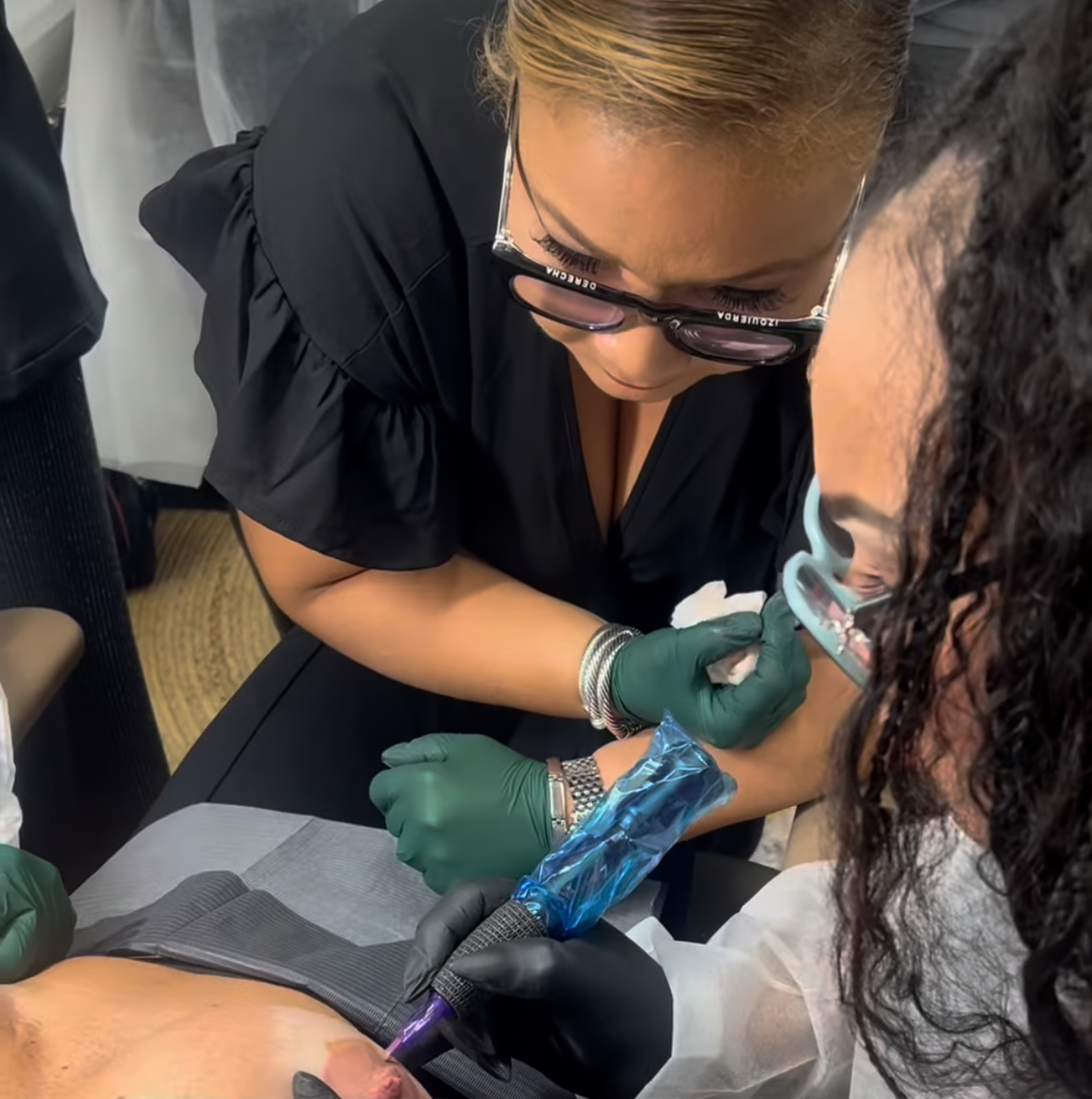
A paramedical tattoo is semi-permanent work performed on your skin. The artist who does it will determine how your scar, areola, or stretch mark looks for the next 5 to 10 years — and how your skin heals afterward. Unlike a decorative tattoo that you can cover up or have removed relatively easily, a paramedical tattoo lives with you. Choosing the right artist is one of the most important decisions you will make in this process.
This guide will walk you through how to evaluate a paramedical tattoo artist, what questions to ask in a consultation, what credentials actually matter, and the red flags that should make you walk away. It was written with input from Healing Skin Medical Aesthetics founder Dr. Cecilia Rusnak, an acupuncture physician, Doctor of Oncology Pain Management, and Master Trainer who has trained paramedical tattoo artists across the country for over three decades.
Why Artist Selection Matters More Than Price
Paramedical tattooing is a clinical procedure that intersects with art. The artist must understand how skin responds to injury and pigment at a physiological level, must be skilled in color theory and pigment blending, and must have the sterile technique of a medical professional. A mistake here is not cosmetic in the way a bad haircut is cosmetic — it shows up as permanent discoloration, uneven texture, or in the worst case, infection or allergic reaction.
Price is the wrong filter for this decision. The cheapest artist in your area may be cheap because they have minimal training or use lower-quality pigments. The most expensive may be expensive because they have invested in top-tier education and equipment — or they may just have good marketing. Neither price nor convenience should drive your choice. Outcomes should.
A well-done paramedical tattoo on a mature scar can make the scar visually integrate with surrounding skin so that it largely stops drawing the eye. A poorly-done paramedical tattoo can produce an obvious, permanent patch of mismatched color that is noticeably worse than the original scar and that is difficult to correct. The gap between these outcomes is entirely about the skill and clinical judgment of the artist.
Credentials That Actually Matter
There is no single national license for paramedical tattoo artists in the United States. Licensing varies by state and is generally much less strict than licensing for medical procedures. That means credentials within the paramedical industry — specific training programs, certification hours, and clinical background — matter more than state license alone.
Here is what to look for. First, a tattoo or cosmetic tattoo license for your state (the legal minimum). Second, a bloodborne pathogens certification (usually OSHA-certified annually). Third, training hours specifically in paramedical tattoo from a qualified instructor — this should be at least 32-40 hours of hands-on training, not a weekend workshop. Fourth, documented experience with your specific type of work (scars, areolas, stretch marks are different skill sets).
A bonus credential that is increasingly valuable: clinical background. Artists with backgrounds in nursing, medical aesthetics, or related clinical work often have better foundation in skin physiology and sterile technique than artists who came from decorative tattoo backgrounds alone. Dr. Cecilia Rusnak holds a Doctorate in Oncology Pain Management and has been treating patients in her integrative wellness practice, AcuMedGroup Wellness Center, since 2015. This kind of clinical foundation is rare and valuable.
Questions to Ask in a Consultation
A consultation is not just a sales pitch from the artist — it is your chance to interview them. Any reputable paramedical tattoo artist will welcome these questions and answer them thoroughly. Reluctance to answer is a red flag.
Ask about their specific training: Where did they learn paramedical tattoo technique? How many hours was the training? Who was the lead instructor and what is their background? Continuing education matters too — what is the most recent training they have completed?
Ask about their experience with your specific work: How many scar camouflage patients have they worked on (or areola, or stretch mark, whichever applies to you)? Can they show you healed results — not just fresh-work photos, but photos taken several weeks after the final session when the pigment has settled? Ask about patients with skin tones similar to yours.
Ask about their process: How do they assess candidacy? How do they blend pigment for your skin tone? What pigment brand do they use and why? What is their protocol if something does not heal as expected? How many sessions will your treatment plan likely require, and what is the cost structure?
Ask about aftercare: What do they recommend you use during the healing period? Do they follow up between sessions? If you have a question or concern, what is their response time? Do they offer touch-ups, and what is the cost?
What to Look For in Their Portfolio
A paramedical tattoo portfolio is not just before-and-after photos. Look specifically for healed results — photos taken at least 4 to 6 weeks after the final session, when the pigment has fully settled into the dermal layer and any post-treatment redness has resolved. Fresh-work photos (taken immediately after a session) look dramatic but do not reflect what the final healed result will look like.
Look for results on skin tones similar to yours. Paramedical tattoo technique varies significantly for lighter (Fitzpatrick I-III) versus darker (Fitzpatrick IV-VI) skin tones. An artist with a portfolio full of beautiful work on one skin type may or may not have the experience and skill to work well with your skin. Dr. Rusnak has built a significant portion of her expertise specifically around darker skin tones, which carry different pigmentation risks and require different technique.
Look for work similar to your situation. An artist who mostly does areola restoration may have less experience with stretch mark camouflage, and vice versa. Scar camouflage requires different skills than color correction for existing tattoos. Pay close attention to whether the artist shows multiple examples of exactly the kind of work you need.
Also notice what is missing. Does the portfolio show variety of skin tones, variety of body areas, variety of scar types? Or does it mostly show one narrow range? Missing diversity can indicate limited experience, which could mean your case is stretching beyond their comfort zone.
Red Flags That Should Make You Walk Away
Certain signs should immediately end your consideration of an artist, no matter how convenient the location or appealing the price. Do not proceed if the consultation is rushed or you feel pressured to book before you are ready. Reputable artists understand this is a major decision and welcome your time to think.
Walk away if the artist cannot show you healed results. Demands to book without seeing healed work are a sign the artist may not have enough experience. Walk away if they cannot articulate their training or dismiss the question. Walk away if they work in a non-sterile environment, use non-single-use equipment, or cannot explain their bloodborne pathogens protocol. Walk away if they promise results that seem too good — “complete removal,” “100% invisible,” “one session and done” — paramedical tattoo is good but not magic, and honest artists set realistic expectations.
Walk away if the artist pressures you into a more expensive treatment plan than you originally discussed, or tries to add services at the last moment. Walk away if they refuse to discuss their aftercare protocol or what happens if something goes wrong. Walk away if they seem uninterested in your specific situation and just want to run you through their standard workflow.
Also walk away from artists who disparage other practitioners to raise themselves. The paramedical tattoo community is small, and real professionals maintain respect for colleagues. Competitive tearing-down is a personality tell, not a professional credential.
The Value of Clinical Specialization
Not all paramedical tattoo artists are equal. Some specialize in one narrow area (such as areola only) and may be excellent at that but limited elsewhere. Some are generalists who do everything reasonably well but not at the expert level for any single specialty. A few artists build genuine deep expertise across multiple related specialties.
For complex cases — surgical scars combined with radiated tissue, post-mastectomy reconstruction with compromised skin, scars across multiple body zones, large stretch mark areas, or any situation that mixes pigment camouflage with techniques like Advanced ISR Inkless or collagen induction therapy — specialization matters. You want an artist who has worked on cases like yours before and who has the clinical judgment to recognize when they are out of their depth and should refer you elsewhere.
At Healing Skin Medical Aesthetics, Dr. Rusnak specializes across the full paramedical spectrum: scar camouflage, 3D areola restoration, Brazilian stretch mark camouflage, and complex combined treatment plans. Her integrative background means she understands how paramedical work fits into broader skincare and healing plans.
When Traveling to a Better Artist Is Worth It
If the local options for paramedical tattoo in your area are limited or unimpressive, traveling to a better artist is usually worth the investment. Here is the math. A well-done paramedical tattoo lasts 5 to 10 years. A poorly-done one may need corrective work that costs significantly more than you saved by going local, or may be effectively uncorrectable. The travel cost of a few flights is small compared to living with a bad result for years.
Many paramedical tattoo artists (Dr. Rusnak included) have patients who travel from other states or even internationally for treatment. Healing Skin Medical Aesthetics is located in Kissimmee, serving Orlando and all of Central Florida, and regularly sees patients from the Southeast, Northeast, and Midwest who choose to travel rather than work with less-qualified artists closer to home. According to the American Society of Plastic Surgeons, paramedical tattoo for post-mastectomy reconstruction is a recognized option specifically because of the clinical significance of the outcomes — which is why traveling for quality makes sense.
Plan your travel around the treatment series. Most paramedical tattoo plans require 2 to 4 sessions spaced 6 to 8 weeks apart. You can often time first and last sessions as a trip, and some patients manage middle sessions with local short flights. Some patients combine sessions with vacation, turning the logistics into a positive experience rather than a burden.
What to Expect During the Consultation
The consultation is the single most revealing interaction you will have with a paramedical tattoo artist before booking. It is where you learn whether they actually understand your situation, whether their communication style matches yours, and whether their clinical judgment feels sound. Most ethical artists offer consultations at little or no cost precisely because they want you to make an informed decision.
A well-structured paramedical tattoo consultation lasts 30 to 45 minutes and covers specific ground. The artist should take a medical history including current medications, skin conditions, allergies, and any contraindications that might make paramedical tattoo inadvisable. They should examine your scar in good lighting and discuss its maturity, stability, and candidacy for camouflage. They should explain realistic expectations — not just what the treatment can do, but what it cannot do.
The artist should also do a skin tone and undertone assessment, typically using the Fitzpatrick scale plus their own clinical observation for warm, cool, or neutral undertones. They should show you pigment samples or digital tone-matching tools to demonstrate how they will approach your specific skin. For complex cases, they should discuss whether a test spot — a small patch treated in an inconspicuous area to see how your skin responds before committing to the full treatment — makes sense for your situation.
By the end of consultation, you should walk away with a clear understanding of the proposed treatment plan (typically 2 to 4 sessions over 3 to 5 months), the cost structure including deposit and session fees, what will be expected of you during the healing weeks between sessions, what aftercare products are recommended, and a timeline for final results. If any of these pieces are vague or missing, that is a reason to slow down before booking.
Making Your Final Decision
After one or more consultations, take 48 hours before making a decision. This is important. Paramedical tattoo is a significant commitment, and you should not book under pressure or on the same day you first meet an artist. Use the waiting time to compare your notes from consultations, look at portfolios again with fresh eyes, and check any reviews or references from past patients.
When you book, you should feel confident about three things. First, that the artist has the right technical skill for your specific situation. Second, that you trust them to tell you the truth about what is and is not possible for your case. Third, that you feel comfortable with their clinic environment and staff. Trust and comfort matter because this is intimate work and the treatment series spans months.
If you are in Central Florida or willing to travel, we would welcome the opportunity to discuss your case at Healing Skin Medical Aesthetics. Dr. Rusnak offers thorough consultations where she evaluates your situation honestly and gives you a clear, no-pressure answer about what paramedical tattoo can and cannot do for you. For at-home support during your treatment series, medical-grade skincare from Dr. Rusnak Wellness is specifically formulated for healing and compromised tissue. To schedule your consultation, call (689) 288-8011.
Red Flags When Evaluating a Paramedical Tattoo Artist
Not every paramedical tattoo artist is properly trained for clinical scar work. Red flags include: no photos of healed scar camouflage work (healed results are what matter, not fresh tattoos), training credentials that appear only on a certificate without verifiable continuing education, refusal to show examples of their work on skin tones similar to yours, pricing dramatically lower than regional averages (often indicates inexperience), and unwillingness to discuss candidacy or cases they have declined.
Questions to Ask Your Paramedical Tattoo Artist
When interviewing a potential paramedical tattoo artist, ask specific questions: How many cases similar to mine have you treated? Can I see healed photos 3+ months post-treatment? What is your aftercare protocol? Who is your instructor or training lineage? Do you have a physician oversight relationship for complex cases? The answers will quickly reveal whether you are working with a genuine specialist or a general cosmetic tattoo artist expanding into paramedical work.