
Is Paramedical Tattooing Covered by Insurance?
What Breast Cancer Survivors, Scar Camouflage Clients, and Paramedical Tattoo Artists Need to Know About Insurance Reimbursement
By Dr. Cecilia Rusnak, LME, AP, DAc | Master Trainer, Healing Skin Medical Aesthetics
Published 2026 | Healing Skin Medical Aesthetics | healing-skin.com

One of the most common questions we hear from breast cancer survivors, burn patients, and individuals living with visible scarring is: “Will my insurance cover paramedical tattooing?”
Understanding the nuances of Paramedical Tattooing Insurance can significantly impact your experience and coverage options.
The short answer is that it depends on your specific plan, the type of procedure, and how the treatment is documented. But the longer answer is far more encouraging than most people expect. Federal law already requires many insurance plans to cover areola tattooing as part of breast reconstruction. And for scar camouflage, burn revision, and vitiligo repigmentation, a growing body of medical billing precedent is making reimbursement increasingly accessible when the procedure is properly documented as medically necessary.
Many clients benefit from learning about Paramedical Tattooing Insurance prior to their procedures.
This is a separate issue from general cosmetic tattoo insurance or permanent makeup insurance, which covers practitioners offering cosmetic services like microblading, lip blushing, and eyeliner tattooing. The insurance reimbursement discussed in this guide is specific to medically necessary paramedical tattooing — procedures that are restorative and reconstructive in nature, not cosmetic enhancement. Additionally, understanding Paramedical Tattooing Insurance is crucial for clients and artists alike.
Having knowledge about Paramedical Tattooing Insurance allows clients to advocate for their coverage rights.
This guide breaks down everything you need to know, whether you are a client preparing to seek reimbursement, a breast cancer survivor navigating reconstruction coverage, or a paramedical tattoo artist learning how to work within the insurance system on behalf of your clients.
Clients should be aware of their Paramedical Tattooing Insurance options before seeking treatments.
The Women’s Health and Cancer Rights Act (WHCRA): The Law That Protects Breast Cancer Survivors
It is important to discuss Paramedical Tattooing Insurance with your healthcare provider to ensure all procedures are properly documented.
The most important piece of legislation for anyone seeking insurance coverage for areola tattooing is the Women’s Health and Cancer Rights Act of 1998 (WHCRA). This federal law requires any group health plan or individual health insurance policy that covers mastectomies to also cover all stages of breast reconstruction, including:
For many, Paramedical Tattooing Insurance serves as a vital part of their recovery process.
-
- Reconstruction of the breast on which the mastectomy was performed
Understanding your rights regarding Paramedical Tattooing Insurance is critical for obtaining necessary treatments.
-
- Surgery and reconstruction of the other breast to achieve symmetry
Documentation is key for Paramedical Tattooing Insurance claims, ensuring you receive appropriate coverage.
-
- External breast prostheses needed before or during reconstruction
Clients are encouraged to familiarize themselves with Paramedical Tattooing Insurance policies before scheduling any procedures.
-
- Treatment of physical complications at all stages of mastectomy, including lymphedema
Researching Paramedical Tattooing Insurance prior to your appointment can help streamline the reimbursement process.
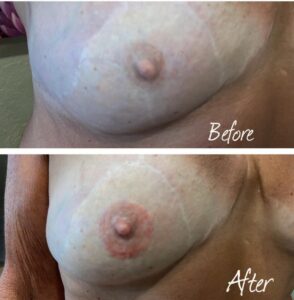
Nipple and areola tattooing is widely recognized as the final stage of breast reconstruction. Plastic and reconstructive surgeons increasingly acknowledge that professional paramedical tattoo artists can achieve results that are often superior to what is available through a surgeon’s office, particularly when using advanced 3D Areola tattooing techniques that create a realistic, dimensional appearance.
Knowledge of Paramedical Tattooing Insurance can empower clients to make informed decisions about their care.
Many clients have successfully navigated Paramedical Tattooing Insurance claims with the right information and support.
While WHCRA provides a strong legal foundation, its language leaves room for interpretation. The law does not explicitly name tattooing in its four covered indications. This has led to inconsistent application across insurance carriers. Private insurance (employer-based and individual plans) generally cover nipple-areola tattooing when performed as part of reconstruction following a mastectomy. Some carriers, such as Blue Cross of Rhode Island, explicitly cover tattooing whether performed by a physician or a licensed tattoo artist.
The landscape of Paramedical Tattooing Insurance is continually evolving, making it essential to stay informed.
Medicare coverage is not federally required under WHCRA, but many Medicare programs follow its principles in practice. Definitions of “medical necessity” under Medicare remain inconsistent, and coverage can vary. Medicaid coverage varies dramatically by state. Louisiana and North Carolina cover areola tattooing as medically necessary. Vermont covers it when prescribed by a licensed provider. Iowa imposes a 12-month time restriction. West Virginia does not cover it at all. Every state has its own interpretation.
Paramedical Tattooing Insurance plays a crucial role in accessibility for those seeking necessary reconstructive procedures.
Important: State and local government plans, as well as church plans, are exempt from WHCRA entirely. It is also worth noting that general tattoo insurance for body piercing and cosmetic work is a completely separate category from the medical reconstruction reimbursement discussed in this guide. Those policies cover practitioner liability, not client treatment costs.
Advocacy for better Paramedical Tattooing Insurance coverage continues to grow among survivors and providers.
Beyond Areola Tattooing: When Is Scar Camouflage Covered by Insurance?
Being proactive about Paramedical Tattooing Insurance can significantly influence the success of your claim.
Insurance companies generally classify cosmetic procedures as non-covered. However, scar camouflage and medical skin repigmentation can qualify for coverage when the procedure meets specific clinical criteria:
Understanding the criteria for Paramedical Tattooing Insurance coverage is essential for a successful reimbursement process.
➤ LINK: Link “scar camouflage” to https://healing-skin.com/scar-camouflage/
Many factors can affect your Paramedical Tattooing Insurance coverage, including state regulations and provider networks.
-
- The procedure is part of post-surgical reconstruction (breast cancer survivors, trauma patients, cleft palate patients)
Engaging with your provider about Paramedical Tattooing Insurance can lead to better outcomes and clearer expectations.
-
- It corrects burn scars or vitiligo, particularly when documentation demonstrates improvement in function or psychological well-being
Following the initial consultation, discussing Paramedical Tattooing Insurance should be a priority for all clients.
-
- It is performed following a covered reconstructive procedure and is documented by a healthcare provider as medically necessary
Each client’s experience with Paramedical Tattooing Insurance is unique, emphasizing the need for customized approaches.
The key phrase in every successful insurance claim is “medically necessary.” When a procedure is documented as serving a functional, reconstructive, or psychological health purpose rather than a purely cosmetic one, the pathway to reimbursement opens significantly. This distinction is what separates paramedical tattooing insurance reimbursement from standard cosmetic tattoo insurance claims, which are almost never covered.
Paramedical Tattooing Insurance not only supports the client financially but also promotes emotional healing.
How Insurance Reimbursement Actually Works for Paramedical Tattooing
As a client, understanding the role of Paramedical Tattooing Insurance can greatly affect your care journey.
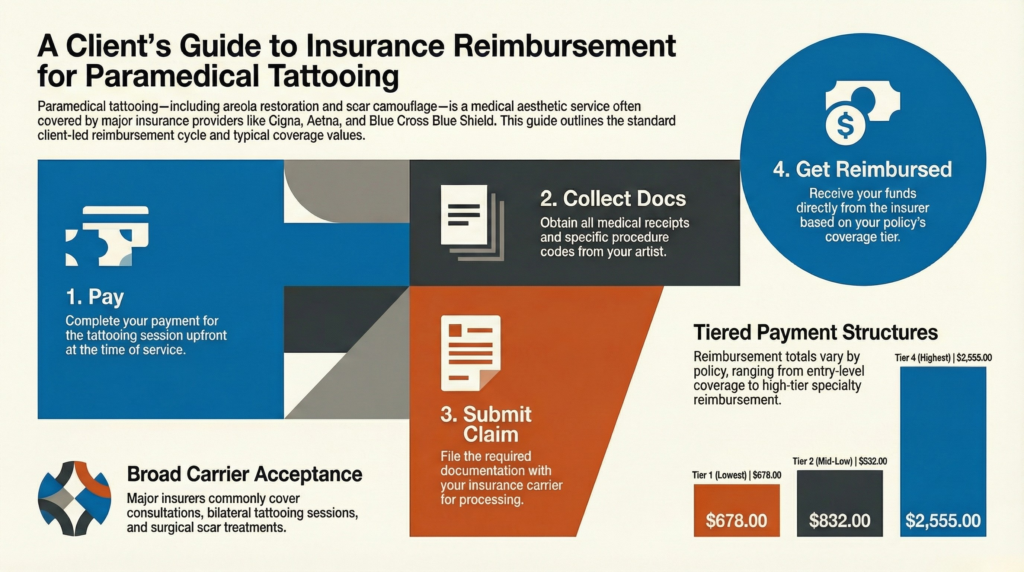
In most cases, the paramedical tattoo artist does not bill the insurance company directly. Instead, the process follows a reimbursement model:
Paramedical Tattooing Insurance should be a key consideration when planning for post-recovery treatments.
-
- The client pays out of pocket at the time of the procedure.
Maintaining clear communication with your provider helps ensure that Paramedical Tattooing Insurance claims are handled smoothly.
-
- The provider supplies documentation including a detailed receipt, procedure description, CPT codes, and any supporting letters.
Staying informed about changes in Paramedical Tattooing Insurance can empower clients to navigate their options effectively.
-
- The client submits the documentation to their insurance company along with the physician referral and medical necessity letter.
Each step in the process of securing Paramedical Tattooing Insurance reimbursement requires careful attention to detail.
- The insurance company processes the claim and reimburses the client directly, typically covering 50–100% of the procedure cost depending on the plan, deductible status, and documentation quality.
Some practitioners choose to partner with medical tattooing billing services that handle the claims process on behalf of the artist. These services manage credentialing, pre-authorization, claim submission, and reimbursement collection. However, the majority of out-of-network paramedical tattoo providers use the client-reimbursement model described above, where the client pays directly and submits for reimbursement independently.
Prior authorization is a critical step that should occur before the procedure. This is initiated by the referring physician’s office, not by the client or the tattoo artist. Prior authorization tells the insurance company in advance that the procedure is planned and medically justified, dramatically improving the likelihood of full reimbursement.
The 5 Documents That Increase Your Chances of Insurance Approval
Whether you are a client preparing to submit a claim or an artist helping your client navigate the process, these five documents form the foundation of a successful insurance reimbursement request.
- Physician Referral and Diagnosis
A written statement from a licensed physician or surgeon confirming the medical necessity of the tattooing procedure. This letter should include the original diagnosis, relevant ICD codes, and a clear statement that the patient is ready for the tattooing stage of their reconstruction or treatment plan.
- Medical Necessity Letter
Written by the referring provider or specialist, this letter explains why the procedure is necessary for the patient’s functional, psychological, or physical well-being. For breast cancer survivors, this typically states that areola tattooing represents the final step of reconstructive surgery following mastectomy and is essential for achieving symmetry, aesthetic restoration, and emotional closure.
- Procedure Details and CPT Codes
A clear outline of the treatment performed, including the size of the treated area measured in square centimeters and the appropriate CPT code. The billing codes most commonly used for paramedical tattooing are:
| CPT Code | Description | Common Applications |
| 11920 | Tattooing, intradermal introduction of insoluble opaque pigments; 6.0 sq cm or less | Small scars, areola repigmentation post-mastectomy, minor burn scars |
| 11921 | Tattooing, intradermal introduction of insoluble opaque pigments; 6.1 to 20.0 sq cm | Moderate-sized scars, larger reconstructive repigmentation |
| 11922 | Each additional 20.0 sq cm (use with 11920 or 11921) | Large-area repigmentation, extensive post-surgical scars |
| 17999 | Unlisted skin procedure | Advanced camouflage techniques where no standard code applies |
- Before and After Photographs
Visual evidence of the treatment area before and after the procedure. Clinical photography should be consistent in lighting, angle, and framing to clearly demonstrate the medical outcome. These images support the medical necessity argument and provide the insurance reviewer with tangible proof of the procedure’s impact.
- Patient Consent and Treatment Plan
A signed informed consent form detailing the procedure, risks, expected outcomes, number of sessions, and the clinical rationale. This document demonstrates that the treatment was planned, medically supervised, and carried out with proper clinical protocols.
State-by-State Variation: Why Coverage Depends on Where You Live
One of the most frustrating realities of paramedical tattoo insurance coverage is that it varies not just by carrier but by state. Medicaid programs in particular have wildly different interpretations of what constitutes medically necessary reconstruction:
- Louisiana considers nipple-areola tattooing medically necessary and covers it under Medicaid.
- North Carolina covers all nipple-areola reconstruction including tattooing and skin grafting under its Medicaid and Health Choice programs.
- Vermont covers nipple-areola tattooing following mastectomy or lumpectomy when prescribed by a licensed provider.
- Iowa requires reconstruction to occur within 12 months of mastectomy for subsequent tattooing to be covered, a restriction not found in any other segment of WHCRA.
- West Virginia does not cover nipple-areola tattooing under Medicaid because it is not classified as medically necessary.
The takeaway: always contact your insurance provider before scheduling your procedure. Ask specifically whether nipple-areola tattooing or medical repigmentation is covered under your plan, request a case manager if available, and ask about the process for out-of-network reimbursement if no in-network provider is available in your area. This applies to all forms of specialized coverage for medical tattooing, regardless of state.
What to Do Before Your Procedure: A Step-by-Step Guide for Clients
If you are a breast cancer survivor, scar camouflage client, or burn patient exploring insurance reimbursement for paramedical tattooing, here is the recommended sequence of steps:
- Call your insurance company. Inform them that you are planning to undergo medical micropigmentation or areola tattooing as part of your reconstruction. Ask whether this is covered, and if so, what documentation they require.
- Obtain a referral from your surgeon or physician. Request a letter of medical necessity that includes your diagnosis, ICD codes, and a statement confirming the tattooing procedure is part of your reconstruction plan.
- Request prior authorization. Have your physician’s office initiate the prior authorization process with your insurer before the procedure takes place.
- Schedule your procedure. Once prior authorization is secured, book your appointment with a qualified paramedical tattoo provider.
- Pay out of pocket and collect all documentation. After your procedure, obtain a detailed receipt with CPT codes, before-and-after photos, and any supplemental letters from your provider.
- Submit your claim. Send all documentation to your insurance company along with the physician prescription and original diagnosis. Follow up within 30 days if you have not received a response.
For Paramedical Tattoo Artists: Why Understanding Insurance Matters
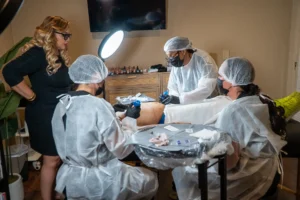
If you are a practicing or aspiring paramedical tattoo artist, understanding insurance reimbursement is not optional. It is a professional skill that directly impacts your ability to serve clients, grow your practice, and operate within the medical referral ecosystem.
Artists who can confidently walk a client through the reimbursement process, provide proper documentation, and communicate with referring physicians are positioned to:
- Build stronger referral relationships with plastic surgeons, oncologists, and dermatologists
- Remove a major financial barrier for clients who would otherwise delay or forgo treatment
- Differentiate their practice from cosmetic tattoo providers who lack clinical documentation knowledge
- Command higher service fees justified by the clinical framework supporting the work
This is also what separates paramedical training from permanent makeup PMU certification programs. Coverage for permanent makeup insurance is purely a liability product that protects the practitioner. Paramedical tattooing insurance reimbursement, by contrast, is a client-facing financial pathway that requires clinical knowledge, proper CPT coding, and medical documentation expertise.
At Dr. Rusnak Academy, insurance documentation, CPT coding, medical necessity letters, and physician referral workflows are part of the curriculum. Students learn not just how to perform the procedure, but how to operate within the clinical and administrative systems that support reimbursement. This is one of the critical differences between cosmetic tattoo training and true paramedical certification.
The Bottom Line
Paramedical tattooing is not a luxury. For breast cancer survivors completing reconstruction, for burn patients seeking normalcy, and for individuals living with visible scars that affect their daily confidence, this is a medically meaningful procedure with a strong legal and clinical foundation for insurance coverage. The Women’s Health and Cancer Rights Act provides a federal baseline. Proper documentation, physician referrals, and prior authorization expand the pathway further.
At Healing Skin Medical Aesthetics, we are committed to helping every client understand their options and access the care they deserve. If you have questions about insurance reimbursement for paramedical tattooing, or if you are a practitioner who wants to learn how to integrate medical billing knowledge into your practice, we are here to help.
Ready to take the next step? Schedule a consultation with our team to discuss your treatment options and insurance reimbursement pathway, or explore the Paramedical Tattoo Certification at Dr. Rusnak Academy to add clinical insurance skills to your practice.
ABOUT THE AUTHOR
Dr. Cecilia Rusnak, LME, AP, DAc is the founder of Healing Skin Medical Aesthetics and Master Trainer at Dr. Rusnak Academy. With over 30 years of clinical experience in integrative medicine and paramedical aesthetics, Dr. Rusnak has trained practitioners nationwide in advanced scar camouflage, stretch mark revision, 3D areola tattooing, and inkless skin restoration techniques.
DISCLAIMER
This article is provided for educational purposes only and does not constitute legal, financial, or medical advice. Insurance coverage varies significantly by plan, state, and individual circumstances. Always consult directly with your insurance provider, medical team, and qualified professionals for guidance specific to your situation. Healing Skin Medical Aesthetics is not a law firm and cannot make determinations regarding insurance eligibility or fair use of medical billing codes.
Ready to Build a Career in Paramedical Tattooing?
Dr. Cecilia Rusnak Academy offers a nationally recognized Paramedical Tattoo Certification — led by a Master Trainer with 30+ years of clinical experience. Classes run in San Diego, Orlando, New York, and Houston.
Schedule a Call to Learn More and Reserve Your Seat
Frequently Asked Questions
Is paramedical tattooing covered by insurance?
Some paramedical tattooing procedures can be covered by insurance when medically necessary. Areola tattooing after mastectomy is typically covered under the Women’s Health and Cancer Rights Act (WHCRA). Scar camouflage may be covered with proper medical necessity documentation using CPT codes 11920-11922.
What CPT codes apply to paramedical tattooing?
CPT codes 11920 (6cm² or less), 11921 (6.1-20cm²), and 11922 (each additional 20cm²) apply to intradermal pigmentation when medically necessary. Code 17999 (unlisted skin procedure) can be used for advanced camouflage techniques not covered by standard codes.
What documentation do I need for insurance coverage?
Required documentation typically includes: medical necessity letter from your physician, photos of the affected area, referral from plastic surgeon or oncologist (for post-surgical cases), and detailed treatment plan. Pre-authorization from your insurance is strongly recommended.
Does Medicare cover paramedical tattooing?
Medicare may cover nipple-areola complex tattooing as part of post-mastectomy breast reconstruction when performed by qualified providers. Coverage is typically under the same guidelines as reconstructive surgery. Verify coverage with your specific Medicare plan before treatment.