
If you’re considering tummy tuck scar camouflage, you’re likely between 6 months and several years post-op, frustrated by a scar that runs hip to hip, and tired of hiding it under high-waisted clothing. The good news: tummy tuck scars are among the most successfully treated scars in the entire scar camouflage specialty. They’re long, but they’re typically thin, predictable in their pigmentation pattern, and respond well to custom-blended paramedical pigments that integrate the scar visually with surrounding skin.
At Healing Skin Medical Aesthetics, tummy tuck scar camouflage is one of the most common procedures performed by Dr. Cecilia Rusnak, our Master Trainer with three decades of clinical experience. This article walks through what tummy tuck scar camouflage actually does, when in your healing timeline you should consider it, what realistic results look like, and how to decide if it’s right for your specific scar.
Important: Every scar heals differently. The outcomes described in this article reflect typical results in appropriate candidates. Your specific case should be evaluated by Dr. Rusnak during a video consultation before any treatment plan is developed.
What Tummy Tuck Scar Camouflage Actually Does
Tummy tuck scar camouflage is a paramedical tattooing technique that deposits skin-tone pigment into the dermal layer of a healed surgical scar. The goal is not to remove the scar (no tattoo can do that) but to reduce the color contrast between the scar tissue and the surrounding skin. After successful camouflage, the scar is still physically present — you’d feel it if you ran your fingertip across it — but visually, it integrates with the skin around it instead of standing out as a pink, white, or darker line.
Most of these scars present as hypopigmented (lighter than surrounding skin) once they’ve matured. Camouflage works exceptionally well on hypopigmented scars because we’re adding pigment back to tissue that lost its melanin during the surgical healing process. Hyperpigmented scars (darker than surrounding skin) and hypertrophic scars (raised above the skin surface) require different treatment approaches and may benefit from combining camouflage with Inkless Scar Revision (ISR) first.
When to Get Tummy Tuck Scar Camouflage After Surgery
Timing is one of the most important variables in your treatment outcomes. The most common mistake patients make is treating too early, while the scar is still actively remodeling — which produces unpredictable results because the scar tissue itself is still changing color, texture, and density.
The 12-Month Minimum Rule
Most reputable paramedical tattoo artists, including Dr. Rusnak, will not perform this work until at least 12 months post-op. This is the typical timeline for a tummy tuck scar to fully mature — meaning the redness has faded, the scar has settled into its long-term color, and the skin is no longer actively healing. Treating before this window risks pigment shift, uneven results, and potentially compromising the scar itself.
The Ideal Window: 12 to 36 Months Post-Op
The sweet spot for treatment is generally between one and three years after surgery. By 12 months, the scar is mature. Before about 36 months, the surrounding skin is still relatively elastic and the dermal layer accepts pigment readily. After that, scars are still treatable — many of our patients come to us 5, 10, or even 20 years post-op with excellent results — but the ideal window for first-time treatment is the early years after maturation.
If Your Surgeon Cleared You Earlier
Some plastic surgeons clear patients for cosmetic scar treatment as early as 6 to 9 months post-op. We recommend checking with your surgeon and getting a video consultation with Dr. Rusnak before scheduling. Even with surgical clearance, premature paramedical tattoo work on a still-remodeling scar can produce results you’ll need to correct later.
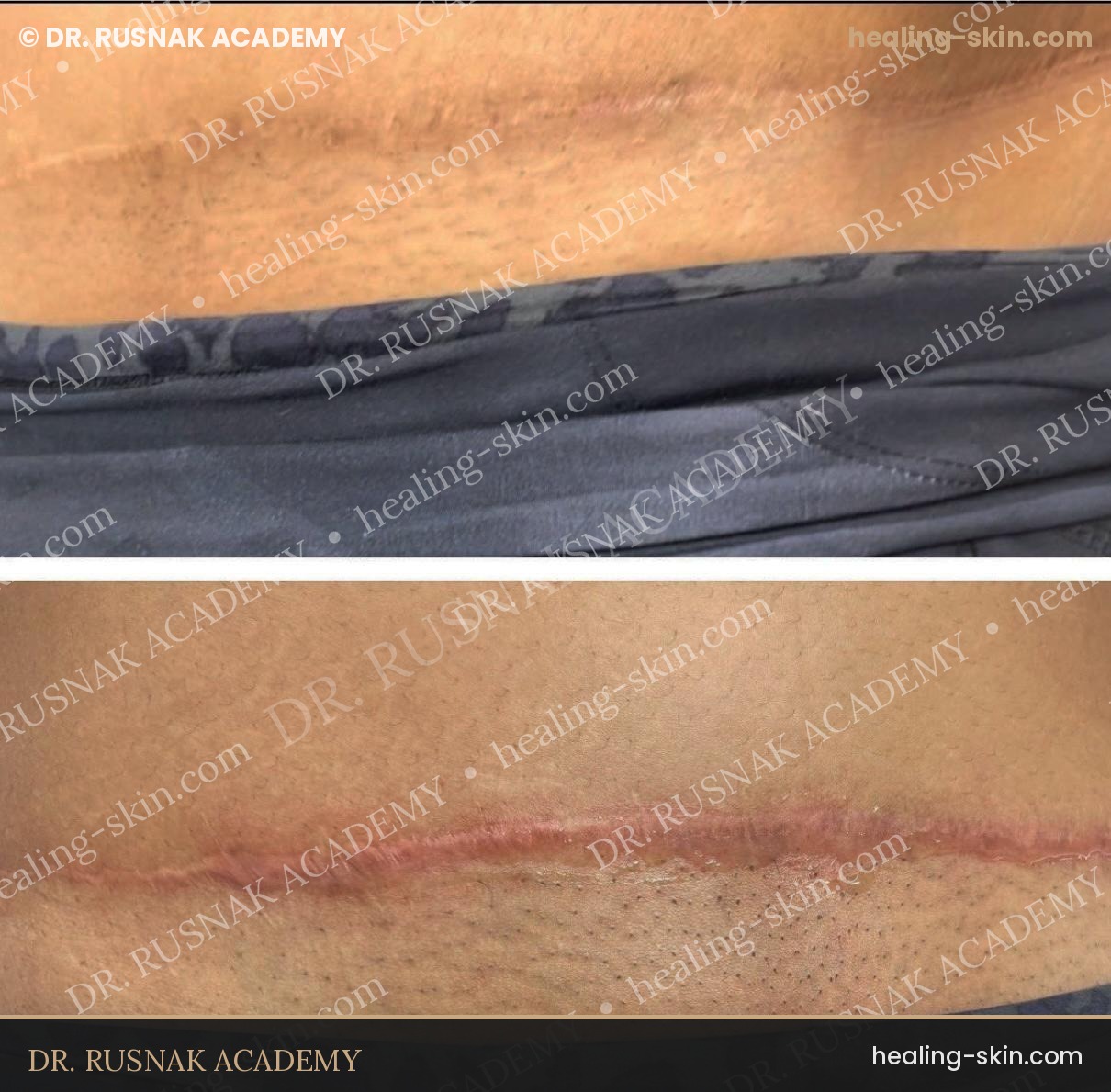
What Realistic Tummy Tuck Scar Camouflage Results Look Like
Patients evaluating this treatment often arrive with one of two unrealistic expectations: that camouflage will erase the scar entirely, or that nothing can really be done so why bother. Both are wrong. The realistic middle ground:
- Visual integration of 70 to 95 percent for most patients with mature, hypopigmented scars across 2 to 4 sessions
- The scar remains physically present — you can still feel the tissue change with your fingertip, and very close inspection in strong light may still show the line
- Results are most visible in normal light and at conversation distance — across a beach, in a swimsuit, or at the gym, most camouflaged scars become genuinely difficult to spot
- Color matching is the variable — patients with stable skin tone year-round have more predictable results than patients whose skin tone shifts dramatically with sun exposure
The single biggest predictor of result quality is the practitioner’s Fitzpatrick assessment and pigment blending skill. Generic pre-blended pigments produce mediocre results. Custom blending using the NUE Conceal medical pigment system — which is what Dr. Rusnak uses for every patient — accounts for your specific undertone, your scar’s specific hypopigmentation pattern, and the seasonal range of your natural skin color.
How Many Sessions This Treatment Requires
Tummy tuck scars are long — typically 8 to 18 inches running hip to hip — and full treatment is typically completed in 2 to 4 sessions spaced 6 to 8 weeks apart. The exact number depends on your scar length, skin tone, and how your skin accepts pigment in early sessions.
| Scar length | Typical sessions needed | Approximate total cost |
|---|---|---|
| Short tummy tuck (8–12 inches) | 2 to 3 sessions | $1,800 – $3,300 |
| Standard tummy tuck (12–16 inches) | 3 sessions | $2,700 – $3,900 |
| Extended/fleur-de-lis (16+ inches with vertical extension) | 3 to 4 sessions | $3,600 – $4,800 |
For full pricing context including how tummy tuck scar camouflage compares to other scar treatments, see our complete guide to scar camouflage cost in 2026.
The Treatment Process at Healing Skin
Step 1: Video Consultation with Dr. Rusnak
Treatment starts with a video call consultation. Dr. Rusnak reviews your scar on camera, asks the medical history questions she would ask in person, performs a preliminary Fitzpatrick assessment based on your visible skin tone, and gives you a personalized treatment plan including realistic session count and pricing. There is no fee for this consultation.
Step 2: Custom Pigment Blending In-Person
On the day of your first session, Dr. Rusnak performs a hands-on Fitzpatrick assessment, examines the scar in clinical lighting, and custom-blends your pigment using the NUE Conceal system. This step alone often takes 20 to 40 minutes and is the single highest-leverage clinical decision in your entire treatment.
Step 3: First Session — Establishing Color
The first session focuses on laying down a foundation color slightly lighter than your final target. Tummy tuck scars vary in color along their length — sometimes pinker near the hips, lighter in the midline — and the first session establishes baseline integration across these variations. You’ll see immediate visible improvement but the scar will appear darker than the final result for the first 1 to 2 weeks as initial color settles.
Step 4: Healing Window (6 to 8 Weeks)
Healing follows a predictable pattern: initial color appears 30 to 50 percent darker than the final result, then lightens significantly over 2 to 4 weeks as the surface layer of skin sheds and the deeper pigment settles into final position. Aftercare during this window — especially products like Dr. Rusnak Wellness Scar Gel — supports clean healing and predictable color retention.
Step 5: Second and Subsequent Sessions
Sessions 2, 3, and (if needed) 4 refine color match and address any areas where pigment retention was uneven. Each session adds 20 to 40 percent improvement to the final result. Most patients reach their final outcome by session 3.
Who Is and Isn’t a Good Candidate for Tummy Tuck Scar Camouflage
Most patients who completed a tummy tuck at least 12 months ago and are healthy enough for elective cosmetic procedures are good candidates. There are a few specific situations where treatment should be delayed or where a different approach is better:
Better Candidates
- Mature hypopigmented (lighter) scars more than 12 months post-op
- Patients with stable skin tone year-round
- Patients whose surgeon has cleared them for cosmetic scar treatment
- Patients with reasonable expectations about visual integration vs. removal
- Non-smokers, or patients who can pause smoking during the healing window
Conditions That Require Delay or Different Approach
- Active hypertrophic or keloid scarring — typically requires ISR or other intervention before camouflage
- Scars less than 12 months post-op — wait for full maturation
- Active pregnancy or breastfeeding — wait for completion
- Recent retinoid use (Accutane within 6 months) — affects healing
- Active autoimmune conditions affecting skin healing — requires medical clearance
- Patients on blood thinners — requires physician coordination
- Patients with significant tanning bed or sun-tanning patterns — pigment match becomes unstable across seasons
Recovery and Aftercare After Treatment
Post-treatment recovery is generally well tolerated. Most patients return to normal activities within 24 hours and experience only minor discomfort during healing.
First 7 Days
The treated area will appear darker, slightly raised, and may scab lightly across the line. You’ll keep the area clean with gentle cleansing twice daily, apply a thin layer of healing balm or scar gel as directed, and avoid soaking in baths, pools, hot tubs, or the ocean. Sun exposure during this window can cause permanent pigment discoloration, so coverage is essential.
Weeks 2 to 4
The treated area transitions to its intermediate color as the surface scab fully sheds. Color appears lighter than the final result during this window. SPF 50+ is non-negotiable during all sun exposure for the first 6 weeks and strongly recommended ongoing — sun damage is the leading cause of long-term pigment fading in scar camouflage tattoos.
Long-Term Color Retention
Properly placed dermal pigment remains stable for approximately 5 years or more in most patients. Long-term retention is improved by consistent SPF use, avoiding harsh chemical exfoliants directly over the treated area, and ongoing use of skin-supporting topicals like the BioPeptide Growth Factor Serum during the first year of healing.
Tummy Tuck Scars vs. Other Scar Treatment Options
Patients researching their options often want to know how camouflage compares to other modalities. Here’s the honest comparison:
| Treatment | What It Does | Best For |
|---|---|---|
| Tummy tuck scar camouflage | Adds skin-tone pigment to blend the scar visually | Mature hypopigmented scars where color is the main concern |
| Laser resurfacing | Stimulates collagen and reduces scar texture | Texture issues, raised scars (does not address color) |
| Surgical scar revision | Cuts and re-closes the scar | Severely thickened or widened scars where surgery is justified |
| Inkless Scar Revision (ISR) | Microneedling with growth factors to remodel scar tissue | Hypertrophic scars, before camouflage on raised tissue |
| Topical scar creams | Modest improvement in color and texture for early scars | Active healing scars under 12 months — minimal effect on mature scars |
For patients with raised or hypertrophic scars, the most common effective sequence is ISR first to flatten the tissue, then camouflage to integrate color. Dr. Rusnak develops these combined treatment plans during consultation. The American Society of Plastic Surgeons publishes detailed reference materials on post-tummy-tuck scarring and revision options that can supplement your research.
Frequently Asked Questions About Tummy Tuck Scar Camouflage
How soon after a tummy tuck can I get scar camouflage?
Most reputable paramedical tattoo artists, including Dr. Rusnak, will not perform tummy tuck camouflage work until at least 12 months post-op. The scar must be fully mature — settled into its long-term color, no longer actively healing — before camouflage can produce predictable, lasting results. Treating earlier risks pigment shift, uneven outcomes, and potentially affecting the underlying scar.
Will scar camouflage make my tummy tuck scar invisible?
No camouflage technique fully removes a scar. Realistic expectations: 70 to 95 percent visual integration for most patients with mature hypopigmented scars across 2 to 4 sessions. The scar remains physically present and may still be visible under very close inspection in strong light, but at conversation distance and in normal lighting, well-camouflaged scars become genuinely difficult to spot.
How much does this treatment cost?
Total treatment cost typically runs $1,800 to $4,800 across 2 to 4 sessions, depending on scar length and complexity. Standard tummy tuck scars (12–16 inches) usually fall in the $2,700 to $3,900 range total. The first video consultation is free and includes a personalized treatment plan with transparent pricing before you commit.
Does the procedure hurt?
Most patients describe the sensation as comparable to a regular tattoo — manageable but not pain-free. Topical numbing is applied before treatment to significantly reduce discomfort during the session. The healing process is generally well tolerated, with mild tenderness for the first 24 to 48 hours and no significant downtime.
Can this treatment cover stretch marks too?
Yes, in many cases. Stretch marks adjacent to or above a tummy tuck scar can often be camouflaged in the same treatment plan, depending on how much surface area is involved and your specific stretch mark coloring. Dr. Rusnak evaluates the full treatment area during your consultation and provides a combined plan when both issues are present.
How long do the results last?
Properly placed dermal pigment remains stable for approximately 5 years or more in most patients with consistent SPF use and good aftercare. Some patients opt for a single touch-up session at the 5 to 7 year mark to refresh color. Long-term retention is significantly improved by sun protection — UV exposure is the leading cause of premature fading.
Is treatment covered by insurance?
Most cosmetic treatment is paid out of pocket because the underlying tummy tuck was elective. Exceptions exist for tummy tucks performed as part of post-bariatric reconstructive surgery, post-mastectomy reconstruction, or repair of injury — in those cases, the camouflage may qualify under reconstructive coverage. Dr. Rusnak’s office prepares medical necessity documentation for qualifying cases.
Does tummy tuck scar camouflage work for melanin-rich skin tones?
Yes, but with important nuances. Patients on Fitzpatrick types IV through VI often present with both hypopigmented scar tissue AND surrounding hyperpigmentation around the scar borders, which requires careful color theory work and sometimes a slightly different treatment sequence. Dr. Rusnak has extensive experience with melanin-rich skin and adjusts the protocol accordingly. We strongly recommend booking with practitioners who specifically demonstrate experience across Fitzpatrick scale types — not all do.
Ready to Get a Personalized Treatment Plan?
Every tummy tuck scar is different, which means every treatment plan and every outcome is different. The only way to get a realistic plan for your specific scar is a video consultation with Dr. Rusnak.
Schedule your video consultation by calling (689) 288-8011 or book online. To explore financing options before your call, you can apply in under two minutes through Cherry, Klarna, or Affirm without affecting your credit score.
For more on what to expect across the full treatment journey, see our companion articles on scar camouflage cost in 2026 and paramedical tattoo financing options. To see real results, browse our before and after gallery.