Best Scar Camouflage Dark Skin — 5 Honest Cases
Scar camouflage on dark skin requires different pigment formulation, different layering, and a different healing timeline than scar work on lighter Fitzpatrick types. This clinical guide is for both patients with Fitzpatrick IV–VI skin considering camouflage and for practitioners learning to do this work correctly.
Scar Camouflage on Dark Skin: What Clients and Artists Need to Know About Fitzpatrick Types IV–VI
A clinical guide to pigment matching, hyperpigmentation risk, inkless vs ink decisions, and realistic outcomes for melanin-rich skin tones
By Dr. Cecilia Rusnak PhD, LME, DAc | Founder, Healing Skin Medical Aesthetics
Published 2026 | healing-skin.com/blog
One of the most common frustrations we hear from clients with deeper skin tones is being told they are not good candidates for scar camouflage. Too many providers, unfamiliar with the unique demands of working on dark skin, default to turning these clients away rather than adapting their approach. The reality is far more nuanced. Scar camouflage on dark skin is not only possible — it can produce remarkable results when performed by a practitioner who understands melanin behavior, undertone identification, and the clinical differences between ink-based camouflage and inkless scar revision.
Scar camouflage dark skin is becoming increasingly recognized for its transformative potential, helping clients regain confidence.
This guide is written for both clients and practitioners. If you have Fitzpatrick type IV, V, or VI skin and you are researching scar camouflage dark skin options, this article will help you understand what to expect, what questions to ask your provider, and what outcomes are realistic. If you are a paramedical tattoo artist looking to expand your skills to serve melanin-rich clients confidently, this article breaks down the clinical foundations you need.
Understanding scar camouflage dark skin options is crucial for achieving the best results.
The Fitzpatrick Scale: Why Skin Type Classification Matters for Scar Camouflage
The Fitzpatrick scale is the standard classification system used in dermatology and paramedical aesthetics to categorize skin by its response to ultraviolet light. It ranges from Type I (very fair, always burns) to Type VI (very dark, never burns). For scar camouflage work, the Fitzpatrick classification is essential because it predicts how melanocytes — the cells that produce melanin — will respond to the controlled trauma of the tattoo needle.
Scar camouflage dark skin techniques require careful consideration of skin type and unique pigmentation challenges.
Clients with Fitzpatrick types IV through VI have melanocytes that are significantly more reactive than those in lighter skin types. This means any form of skin trauma — including paramedical tattooing — carries a higher risk of triggering post-inflammatory hyperpigmentation (PIH), a condition where the skin darkens around or within the treatment area in response to the procedure itself. Understanding this risk is what separates a competent scar camouflage practitioner from one who creates more problems than they solve.
The American Academy of Dermatology has documented that post-inflammatory hyperpigmentation is one of the most common dermatologic concerns in patients with skin of color, reinforcing why Fitzpatrick classification is a critical first step in any scar camouflage consultation.

Here is how Fitzpatrick types IV–VI respond to scar camouflage work and what each skin type requires from the practitioner:
Why Scar Camouflage on Dark Skin Requires a Different Approach
The reason so many practitioners turn away clients with darker skin is not that the procedures do not work. It is that the standard approach designed for lighter skin types does not transfer directly. Scar camouflage on Fitzpatrick I–III skin is relatively straightforward: the scar is typically lighter (hypopigmented) than the surrounding skin, and the practitioner matches a flesh-tone pigment to the surrounding area, depositing it into the scar to blend it visually. The margin for error is wider because melanocyte activity is lower and PIH risk is minimal.
Proper scar camouflage dark skin methods can yield impressive results, but they require specialized training.
On dark skin, several additional variables come into play:
- Hyperpigmentation risk is significantly elevated.
The tattoo needle creates controlled micro-trauma in the dermis. In melanin-rich skin, this trauma stimulates melanocyte overproduction, which can cause the treated area to darken rather than blend. This is the opposite of the intended outcome. The risk increases with aggressive needle depth, excessive passes, high machine speed, and improper aftercare.
- Undertone complexity increases with darker skin.
Lighter skin tones tend to have relatively predictable warm or cool undertones. Darker skin tones present a much wider range of undertone variation — red, golden, olive, copper, mahogany, blue-black — and these undertones shift depending on the body area, scar maturity, and surrounding melanin density. Color matching on dark skin requires advanced pigment theory and often multiple rounds of layered application.
-
- Scar tissue behaves differently on melanin-rich skin.
For effective scar camouflage dark skin treatment, practitioners must understand individual skin characteristics.
Keloid and hypertrophic scarring are significantly more common in Fitzpatrick types IV–VI. Scar camouflage tattooing cannot be performed on raised or keloid scars. Clients with a history of keloid formation may need medical scar revision — including steroid injections, silicone sheeting, or surgical excision — before scar camouflage dark skin tattooing can even be considered.
- Dark (hyperpigmented) scars require a completely different technique than light (hypopigmented) scars.
Most scar camouflage training focuses on light scars — adding pigment to darken a pale scar to match the surrounding skin. Dark scars on melanin-rich skin require the opposite approach: neutralization. The practitioner must use complementary color theory to cancel out the excess darkness (typically using orange, peach, or warm-toned pigments to neutralize blue-black or purple hyperpigmentation) before any skin-tone matching can begin. This is a specialized skill that most basic camouflage courses do not cover.
Inkless vs Ink-Based Camouflage: Which Approach Is Best for Dark Skin?
One of the most important decisions in scar camouflage dark skin treatment is whether to use an ink-based approach, an inkless approach, or a combination of both. Each has distinct advantages depending on the scar type, skin type, and treatment goal.
Inkless scar revision (Advanced ISR)
This technique uses a tattoo machine without pigment, combined with specialized serums, to create controlled micro-trauma that stimulates collagen production and natural melanin regeneration. For darker skin types, inkless revision is often the preferred first-line treatment because it avoids introducing foreign pigment into reactive melanocytes. The body’s own healing response can restore natural skin tone from within, particularly on stretch marks and hypopigmented scars. Results develop gradually over 8–12 weeks as collagen remodels and melanin redistributes.
Ink-based scar camouflage
Scar camouflage dark skin requires an understanding of melanin and how it affects treatment outcomes.
This approach deposits medical-grade skin-tone pigment into the scar to visually blend it with the surrounding skin. It is most effective on mature, flat, hypopigmented (lighter) scars that have stabilized in color — typically at least 12 months post-injury or surgery. On dark skin, ink-based camouflage requires meticulous undertone analysis, pigment layering in thin washes rather than heavy saturation, and conservative machine settings to minimize PIH risk.
Combined approach
For many Fitzpatrick IV–VI clients, the most effective protocol begins with one or more inkless revision sessions to improve scar texture, stimulate natural melanin production, and reduce any existing hyperpigmentation. Once the scar has responded to inkless treatment and the tissue is stable, ink-based camouflage can be applied in controlled layers to refine the color match. This staged approach produces the most natural, long-lasting results while minimizing the risk of adverse pigmentation responses.
Scar camouflage dark skin treatment can significantly improve the appearance of unwanted scars.
Color Theory for Dark Skin: How Practitioners Match Pigment to Melanin-Rich Tones
Color matching on dark skin is the single most technically demanding aspect of scar camouflage. It requires an understanding of three principles working simultaneously:
Undertone identification.
The practitioner must identify whether the client’s skin has warm (golden, red, copper), neutral, or cool (blue, mahogany, ash) undertones. This is assessed not just on the treatment area but on the surrounding healthy skin, because scar tissue often shifts undertone from the original skin. The NUE Conceal skin tone reader technology used in our training provides objective color data, but clinical judgment and experience remain essential.
Each scar camouflage dark skin case is unique and requires a tailored approach for best results.
Color neutralization for dark scars.
When a scar is darker than the surrounding skin (hyperpigmented), the practitioner must first neutralize the excess pigmentation before matching the surrounding tone. Orange-based pigments cancel blue-black undertones. Peach-based pigments cancel purple undertones. Yellow-based pigments cancel red-brown undertones. This is applied in thin, controlled layers — overcorrection creates an unnatural warm spot that is just as visible as the original scar.
Layered pigment application.
Understanding scar camouflage dark skin techniques is essential for practitioners aiming for client satisfaction.
Unlike camouflage on lighter skin, where a single well-matched pigment application may produce an acceptable result, dark skin camouflage almost always requires multiple sessions with thin pigment washes. Each session builds depth and dimension, allowing the practitioner to adjust for how the pigment heals and settles in melanin-rich tissue. Rushing this process — applying too much pigment in a single session — is the most common cause of poor outcomes on dark skin.
Who Is a Good Candidate for Scar Camouflage on Dark Skin?
Not every scar on every skin type is appropriate for scar camouflage dark skin treatment. The best candidates meet the following criteria:
-
- The scar is at least 12 months old and has stabilized in color and texture
- The scar is flat or minimally raised — not keloid or actively hypertrophic
Scar camouflage dark skin treatment can help clients feel more comfortable and confident in their appearance.
- The scar is lighter (hypopigmented) or moderately darker (hyperpigmented) than the surrounding skin
- The client does not have a history of keloid formation in the treatment area
- The client is not currently on isotretinoin (Accutane) or blood-thinning medications
- The client is willing to commit to multiple sessions spaced 6–8 weeks apart
- The client understands that results on dark skin develop gradually and may require 3–4 sessions for optimal blending
Candidates who may need pre-treatment before camouflage:
-
- Clients with active keloid or hypertrophic scarring (medical scar revision first)
Consultations for scar camouflage dark skin should cover all aspects of the treatment process and expectations.
- Clients with significant post-inflammatory hyperpigmentation around the scar borders
- Clients whose scars are still pink, red, or actively changing color
A thorough consultation is essential before any treatment begins. At Healing Skin Medical Aesthetics, every scar camouflage case on darker skin starts with a clinical assessment, a patch test to evaluate the skin’s pigment response, and an honest conversation about realistic outcomes. Schedule a consultation to discuss your specific case with our clinical team.
Common Scars Treated with Camouflage on Dark Skin
The types of scars most commonly treated with scar camouflage on Fitzpatrick IV–VI skin include:
Scar camouflage dark skin is particularly effective for a variety of scars, including surgical and traumatic scars.
Tummy tuck and C-section scars.
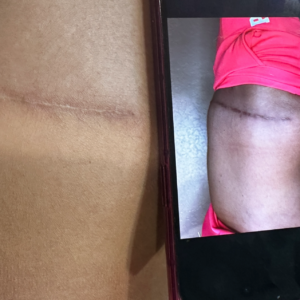
These horizontal abdominal scars are among the most requested treatments. On darker skin, they often present with both hypopigmented scar tissue and hyperpigmented borders, requiring a combined neutralization and matching approach.
Breast lift and reduction scars.
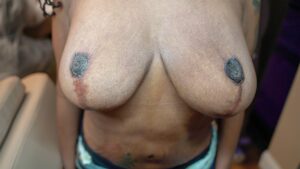
Vertical and anchor-pattern scars on the breast are common in clients with darker skin who have undergone breast surgery. The proximity of scar tissue to the areola adds color-matching complexity.
Stretch marks.
The impact of scar camouflage dark skin can be life-changing for many clients seeking aesthetic improvements.
White or silver stretch marks on dark skin create a stark contrast that many clients find deeply distressing. Stretch mark camouflage on dark skin is one of the most impactful treatments we perform — the visual contrast reduction is dramatic, and clients frequently describe the experience as life-changing.
Vitiligo patches.
Vitiligo camouflage on dark skin is particularly meaningful because the depigmented patches are most visible against melanin-rich surrounding skin. Stable, non-spreading vitiligo responds well to careful ink-based repigmentation, though the client must understand that the camouflage will not change with seasonal tanning.
Burn scars and trauma scars.
These scars present the widest range of texture and color variation. Depending on the severity, a combination of inkless revision and layered ink camouflage may be required across 4–6 sessions.
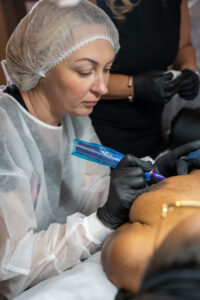
What to Expect During and After Treatment
Clients undergoing scar camouflage dark skin procedures can expect a comprehensive treatment plan.
If you are a client with Fitzpatrick IV–VI skin preparing for scar camouflage, here is what the treatment process typically looks like:
Consultation and patch test.
Your practitioner will assess the scar, identify your Fitzpatrick type and undertones, and perform a small patch test in an inconspicuous area. This test reveals how your melanocytes respond to the needle and pigment, allowing the practitioner to calibrate their approach before treating the full area. The patch test heals over 4–6 weeks.
Treatment sessions.
During treatment, clients will experience the intricacies of scar camouflage dark skin applications.
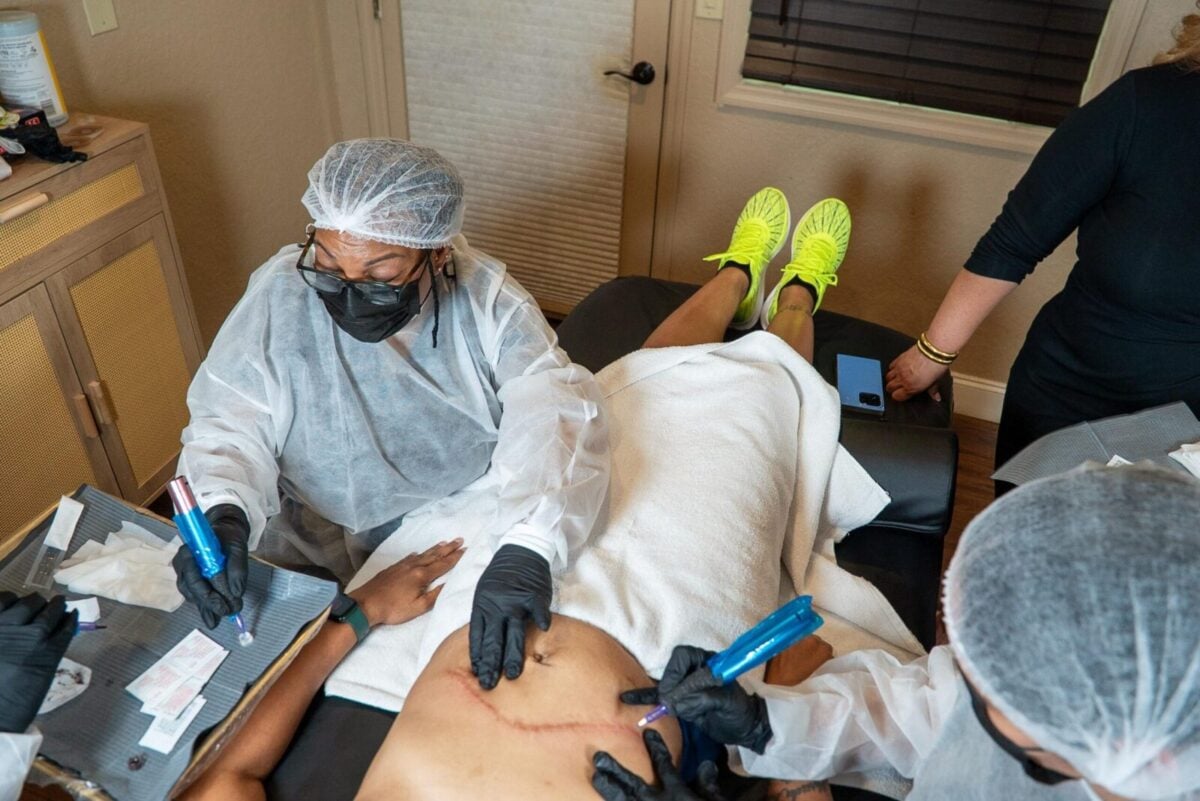
Each session lasts 1–3 hours depending on the treatment area. The practitioner works in thin layers, building color gradually. Multiple sessions are standard — typically 3 to 4 for optimal results. Sessions are spaced 6–8 weeks apart to allow full healing between rounds.
Healing timeline.
Immediately after treatment, the area will appear red, raised, and darker than the final result. Over the first 1–2 weeks, the redness subsides and the pigment begins to settle. Between weeks 2–4, the treated area transitions through a brown phase. By weeks 4–8, the true healed color emerges. On dark skin, this healing arc is longer and more variable than on lighter skin, which is why patience and multiple sessions produce the best outcomes.
Aftercare.
Sun protection is critical. UV exposure can trigger additional hyperpigmentation in the treated area, undoing the careful color matching. Clients should use SPF 50+ on the treatment area, avoid retinoids and exfoliating acids during healing, keep the area moisturized, and avoid submerging the area in water for the first 7–10 days. Using a high-quality, gentle skincare regimen during the healing period supports pigment retention and skin barrier recovery. The Dr. Rusnak Wellness skincare line was developed specifically to complement post-procedure healing with vegan, paraben-free formulations designed for sensitive and treated skin.
Successful scar camouflage dark skin requires diligent aftercare to maintain pigmentation results.
Why Training Matters: Building Confidence to Serve Every Skin Type
▼ IMAGE: Dr. Rusnak training students or performing procedure. Alt text: “Dr. Cecilia Rusnak PhD, LME, DAc, teaching scar camouflage techniques for dark skin tones at Dr. Rusnak Academy paramedical tattoo training” ▼
Investing in training for scar camouflage dark skin techniques is critical for practitioners.
The reason so many paramedical tattoo artists turn away clients with darker skin is not a lack of willingness — it is a lack of training. Most certification programs teach scar camouflage techniques optimized for Fitzpatrick I–III skin and spend minimal time on the advanced color theory, pigment layering protocols, and hyperpigmentation scar treatment strategies required for melanin-rich skin types.
At Dr. Rusnak Academy, the 3-Day Paramedical Tattoo Certification covers scar camouflage across all Fitzpatrick types, including dedicated instruction on undertone identification for darker skin, inkless-first protocols for PIH-prone clients, dark scar neutralization using complementary color theory, and the layered pigment application techniques that produce safe, natural results on Fitzpatrick IV–VI skin. Students work on live models with diverse skin tones during training, not just latex practice skins.
If you are a practitioner who has been turning away clients of color because you were not trained to serve them confidently, this is the skill gap worth closing. The demand for scar camouflage dark skin treatment is growing, and the providers who can deliver safe, effective results on every skin type will build the strongest, most referral-driven practices in the industry.
Practitioners offering scar camouflage dark skin must be prepared for the growing demand in this field.
Ready to take the next step? If you are a client researching scar camouflage options for darker skin, schedule a consultation with our clinical team. If you are a practitioner ready to expand your skills to serve every Fitzpatrick type, explore the Paramedical Tattoo Certification at Dr. Rusnak Academy.
Clients seeking scar camouflage dark skin options can look forward to innovative treatments and methodologies.
ABOUT THE AUTHOR
Dr. Cecilia Rusnak PhD, LME, DAc is the founder of Healing Skin Medical Aesthetics and Dr. Rusnak Academy. Dr. Rusnak is also a state-licensed Acupuncture Physician and the owner of AcuMedGroup Wellness Center, where her clinical background in integrative medicine and skin physiology directly informs her approach to paramedical tattoo training and scar treatment. With 32 years of clinical experience, Dr. Rusnak has trained practitioners nationwide in advanced scar camouflage, stretch mark revision, Areola Color Restoration (3D areola technique) tattooing, and inkless skin restoration techniques across all Fitzpatrick skin types.
DISCLAIMER
This article is for educational purposes only and does not constitute medical advice. Scar camouflage outcomes vary based on individual skin type, scar maturity, medical history, and practitioner skill. Always consult with a qualified practitioner for a clinical assessment before undergoing any paramedical tattoo procedure.
Ready to Build a Career in Paramedical Tattooing?
Dr. Cecilia Rusnak Academy offers a nationally recognized Paramedical Tattoo Certification — led by Dr. Cecilia Rusnak PhD, LME, DAc, with 32 years of clinical experience. Classes run in Orlando, New York, Houston, and Las Vegas.
Schedule a Call to Learn More and Reserve Your Seat
Frequently Asked Questions
Is scar camouflage effective on dark skin?
Yes, scar camouflage works effectively on dark skin when performed by an experienced practitioner. Dr. Cecilia Rusnak specializes in color-matched techniques that account for the unique melanin concentrations and healing characteristics of darker skin tones, producing natural-looking results.
Why does scar camouflage on dark skin require a different approach?
Dark skin contains more melanin, which affects how pigments integrate and heal. Post-inflammatory hyperpigmentation risks are higher, requiring specialized pigment selection, custom color mixing, and modified techniques. Ink-based and inkless methods each have specific applications for darker skin.
What’s the difference between inkless and ink-based scar camouflage?
Inkless scar revision (ISR) uses specialized serums to stimulate natural pigmentation recovery without introducing external pigments—ideal for dark skin. Ink-based camouflage deposits matched pigments into the skin. Inkless methods often work better for hypopigmented scars on dark skin.
How many sessions are needed for scar camouflage on dark skin?
Most patients require 3-5 sessions spaced 6-8 weeks apart for optimal results. Sessions allow the skin to heal and the practitioner to refine color matching. Touch-ups may be needed every 2-3 years to maintain results as skin naturally evolves over time.
Continue Your Results at Home
Recommended take-home support from Dr. Rusnak’s physician-formulated skincare line. Shop the full collection on Dr. Rusnak Wellness →

Scar Repair Silicone Gel
Medical-grade silicone is the gold standard for protecting freshly treated tissue. Used twice daily after scar camouflage on Fitzpatrick IV-VI skin tones, it keeps the area hydrated, softens texture, reduces redness, and locks in your results during the critical settling weeks.

Healing Support SPF 40
Healing Support SPF 40 is the daily UV armor we send home with clients receiving scar camouflage on Fitzpatrick IV-VI skin tones. Broad-spectrum mineral SPF prevents pigment shift, post-inflammatory hyperpigmentation, and premature fading — apply every morning, reapply mid-day.