
When to Get 3D Areola Tattoo After Mastectomy — 4 Best Signs
When to get 3D areola tattoo after mastectomy is one of the most common questions in breast reconstruction. The answer depends on tissue healing, completion of radiation if any, and your plastic surgeon’s clearance. This guide walks through the 4 best signs you’re ready. For the service overview, see 3D Areola Tattoo.
Patients researching 3d areola tattoo timing after mastectomy are usually somewhere in the middle of their reconstruction journey — past the initial mastectomy, into reconstruction, and trying to figure out when in the timeline 3D areola tattooing actually happens. The honest answer: it depends on your specific reconstruction path and your plastic surgeon’s clearance, but there’s a reasonably consistent framework that applies to most patients.
At Healing Skin Medical Aesthetics in Kissimmee, Florida, Dr. Cecilia Rusnak has performed post-mastectomy 3D areola restoration for patients across the country. This article walks through the typical timing framework, what your plastic surgeon will check before clearing you, and how to coordinate the conversation between your reconstructive surgeon and your paramedical tattoo provider.
Important: This article is educational, not clinical advice. Your specific 3d areola tattoo timing after mastectomy should be determined by your reconstructive surgeon based on your individual healing, reconstruction type, and any complicating factors like radiation or chemotherapy. The framework below describes typical timing — your timeline may vary.
Why 3D Areola Tattoo Timing After Mastectomy Matters
Getting 3d areola tattoo timing after mastectomy right matters because the tissue you’re working on is post-surgical. It’s thinner than original tissue, often partially denervated, sometimes radiated, and still actively healing for months after each reconstructive procedure. Treating too early produces three predictable problems:
- Pigment shift — Tissue still in active healing absorbs and migrates pigment unpredictably — the most common 3d areola tattoo timing after mastectomy mistake, leading to color that doesn’t match your final result
- Compromised reconstruction — Microtrauma to actively healing reconstructed tissue can interfere with the reconstruction itself, particularly with implant-based reconstructions or after radiation
- Symmetry problems — Tissue continues to settle and stabilize for months after each surgical step; tattoo work done before stabilization can produce asymmetry once the tissue settles into final position
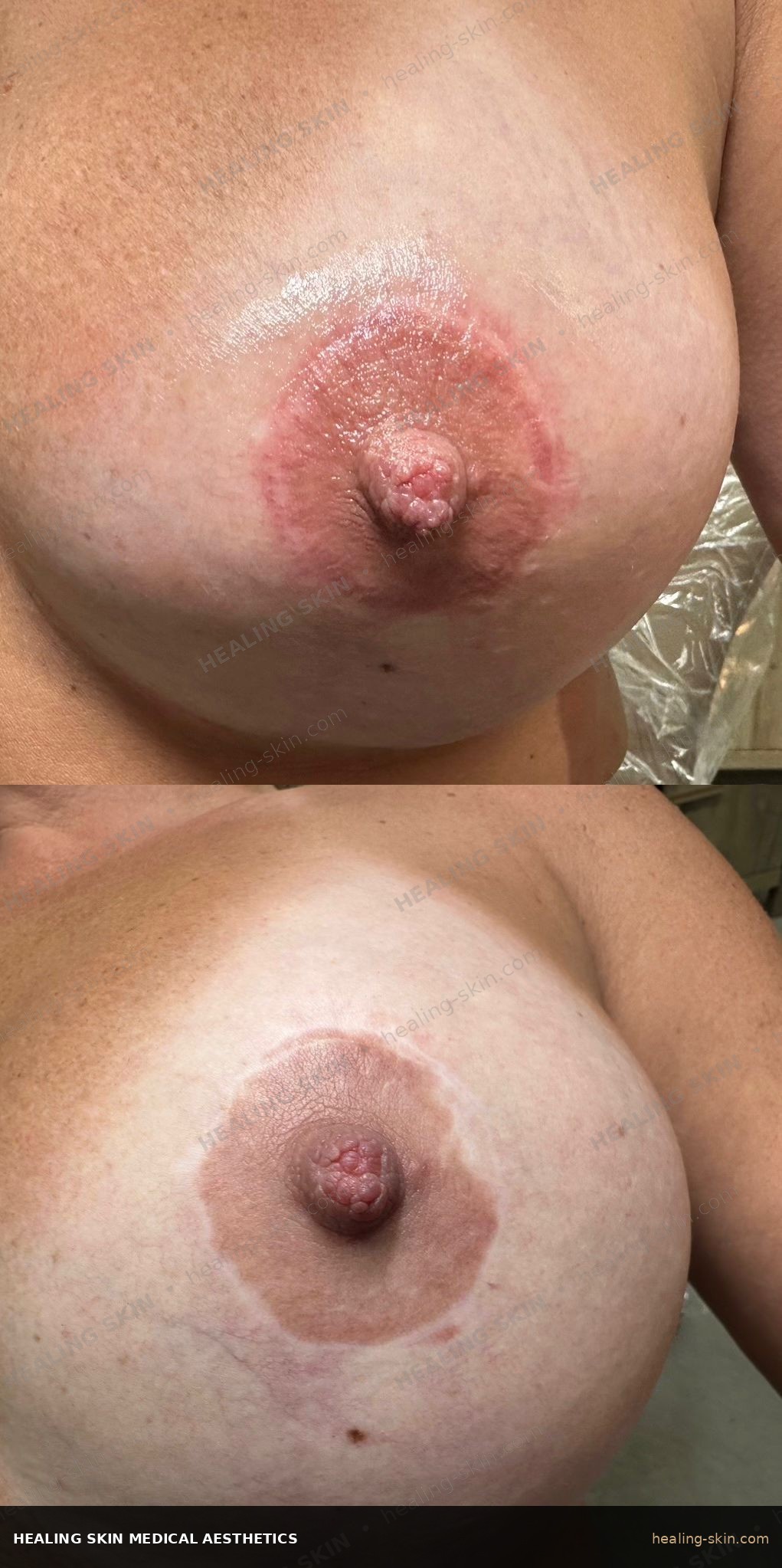
Done at the right time, 3D areola tattoo restoration produces stable, realistic, dimensional results that hold up over years. Done too early, the same procedure can produce results you’ll need to correct or redo. The waiting is worth it.
The Typical 3D Areola Tattoo Timing Framework
Most patients follow a recognizable 3d areola tattoo timing after mastectomy framework from initial surgery through completion of reconstruction to areola tattoo work. The exact months vary, but the sequence is fairly consistent.
| Stage | Approximate Timing | What’s Happening |
|---|---|---|
| Mastectomy | Day 0 | Initial breast tissue removal; immediate or delayed reconstruction begins |
| Reconstruction stage 1 (tissue expander or initial reconstruction) | Day 0 to ~6 months | Tissue expansion or initial reconstructive surgery |
| Reconstruction stage 2 (final implant or autologous final) | ~3 to 9 months post-mastectomy | Final reconstruction completed |
| Settling and healing window | ~6 to 12 months post-final-reconstruction | Tissue settles, scars mature, sensation partially returns |
| Plastic surgeon clearance for cosmetic finishing | ~9 to 12+ months post-final-reconstruction | Surgeon confirms tissue is stable enough for cosmetic work |
| 3D areola tattoo session 1 | After surgical clearance | Initial pigment work, dimensional shading, color matching |
| 3D areola tattoo refinement session | 6 to 8 weeks after session 1 | Color refinement, dimensional adjustment |
| Final result settles | 8 to 12 weeks after session 2 | Final color and dimension stabilize |
From start to final 3d areola tattoo timing after mastectomy completion: roughly 18 to 36 months for most patients. From plastic surgeon clearance to final tattoo result: approximately 3 to 4 months.
What Your Plastic Surgeon Will Check Before Clearing You for 3D Areola Tattoo Work
3D areola tattoo timing after mastectomy is ultimately determined by your reconstructive surgeon — the gatekeeper of 3d areola tattoo timing after mastectomy, and there’s a reasonably consistent set of things they’ll check before signing off.
1. Tissue Maturity
Reconstructed tissue takes 6 to 12 months after final reconstruction to fully mature — meaning swelling has resolved, scars have settled into long-term position, and the tissue has reached stable shape and contour. Your surgeon will assess whether your tissue is fully mature before clearing you. Implant-based reconstructions typically reach maturity faster than autologous (DIEP, TRAM, latissimus dorsi) reconstructions.
2. Scar Maturity
Mastectomy scars and any reconstruction-related incisions need to be fully matured — typically requiring at least 12 months from the most recent surgical procedure. Scars that are still actively remodeling can affect the surrounding tissue’s response to tattoo pigment work.
3. Radiation Effects (If Applicable)
Patients who underwent radiation as part of cancer treatment have additional considerations. Radiated skin is thinner, more fragile, and can have unpredictable pigment retention. Most reconstructive surgeons require an additional waiting period — often 6 to 12 months beyond standard healing — for radiated tissue before clearing for cosmetic finishing. Some patients with significant radiation effects are not optimal candidates for traditional tattoo-based areola restoration; alternative approaches may be more appropriate.
4. Overall Health and Healing Status
Patients on active chemotherapy, those with autoimmune conditions affecting healing, and patients on certain medications may need additional waiting periods or alternative approaches. Your reconstructive surgeon coordinates with your oncologist when these factors apply.
How to Coordinate 3D Areola Tattoo Timing Between Your Surgeon and Your Tattoo Provider
The handoff between your reconstructive surgeon and your paramedical tattoo provider is one of the steps most patients find logistically confusing. Here’s the practical framework:
Start the Conversation Early
Many patients schedule their first video consultation about 3d areola tattoo timing after mastectomy months before they’re cleared for treatment. This serves three purposes: you get a sense of the provider’s approach and whether you trust them, you can ask questions about what to expect that you can then bring to your reconstructive surgeon, and you can plan financing and travel timing well in advance. Healing Skin offers free video consultations for exactly this reason.
Get Your Surgeon’s Clearance in Writing
When your surgeon clears you for cosmetic finishing, ask for a brief written or emailed note specifying that you’re cleared for post-mastectomy 3D areola tattoo work. This serves as documentation for your tattoo provider and as supporting evidence for any insurance reimbursement claim under the WHCRA.
Bring Your Surgical Records to Your First Tattoo Consultation
Operative reports from your mastectomy and reconstruction surgeries help your tattoo provider plan around what was done. Skin sparing vs. nipple sparing mastectomies, implant vs. autologous reconstruction, presence or absence of radiation — all affect how the paramedical tattoo work is approached. You don’t need full medical records, but the operative report summary is extremely helpful.
Plan for Follow-Up Communication
Quality paramedical tattoo providers handling 3d areola tattoo timing after mastectomy will document the procedure and provide photos to your reconstructive surgeon’s office on request. This continuity of care is meaningful when issues arise and is also part of the documentation insurance carriers may request. Healing Skin coordinates this documentation as part of the standard treatment process.
Frequently Asked Questions About 3D Areola Tattoo Timing After Mastectomy
How long after a mastectomy should I wait for 3D areola tattoo work?
Most patients are ready 12 to 18 months after their final reconstruction surgery, once tissue has fully healed and the reconstructive surgeon has cleared them for cosmetic finishing. Patients who underwent radiation may wait an additional 6 to 12 months for tissue recovery. Your specific timing depends on your reconstruction type and your surgeon’s clearance — there is no single correct answer that applies to everyone.
Why does this timing matter so much?
Treating too early produces predictable problems: pigment shift in still-healing tissue, potential interference with reconstruction (especially with implants or after radiation), and asymmetry as tissue continues to settle. Done at the right time, 3D areola tattoo work produces stable, realistic results that hold up over years. The waiting is genuinely worth it.
Can my plastic surgeon and paramedical tattoo artist coordinate directly?
Yes, and they should. Quality paramedical tattoo providers like Healing Skin maintain communication with reconstructive surgeons through written clearance documentation, surgical record review, and procedure documentation that can be shared back to the surgeon’s office. This continuity of care benefits the patient and is often required for WHCRA insurance reimbursement.
What if I had radiation? Does that change 3D areola tattoo timing?
Yes, often significantly. Radiated tissue is thinner, more fragile, and can have unpredictable pigment retention. Most reconstructive surgeons require an additional 6 to 12 months beyond standard healing before clearing radiated patients for tattoo work. Some patients with significant radiation effects may benefit from alternative approaches discussed during consultation. Dr. Rusnak evaluates radiation history specifically during your free video consultation.
Do I need my plastic surgeon’s clearance before booking a 3D areola tattoo consultation?
No, you can book a free video consultation any time during your reconstruction journey to learn about the process, ask questions, and plan timing. Many patients consult with us 6 to 12 months before they’re actually cleared for treatment. The treatment itself requires written or verbal clearance from your reconstructive surgeon, but the conversation can start much earlier.
How long does the full 3d areola tattoo timing after mastectomy process take from start to finish?
Once you’re cleared for treatment, the full process typically takes 8 to 12 weeks: initial tattoo session, 6 to 8 week healing window, refinement session, and final settling. Most patients complete the entire process in 2 sessions. From the date of your mastectomy to your final 3D areola tattoo result, the typical total timeline is 18 to 36 months.
Can I get 3D areola tattoo work done if I haven’t completed my reconstruction yet?
Generally no. 3D areola tattoo work requires that reconstruction is complete and fully healed, since the tattoo is designed to integrate with final tissue position and contour. If you’re between reconstruction stages, schedule a video consultation to plan timing — but actual tattoo work happens after final reconstruction is complete and cleared.
Where can I get post-mastectomy 3D areola tattoo work in Florida?
Healing Skin Medical Aesthetics in Kissimmee — approximately 25 minutes south of Orlando — performs post-mastectomy 3D areola restoration with Dr. Cecilia Rusnak. We coordinate with reconstructive surgeons across the country, prepare insurance documentation under the WHCRA for qualifying patients, and accept patients who travel to Orlando International Airport for treatment. Free video consultations are available before any travel.
Start the 3D Areola Tattoo Conversation Early
Even if you’re months away from being cleared for treatment, starting the conversation now lets you plan the financial, logistical, and emotional sides of 3d areola tattoo timing after mastectomy well ahead of treatment. Free video consultations with Dr. Rusnak are available at any stage of your reconstruction journey.
Schedule your free video consultation by calling (689) 288-8011 or book online. We can talk through your specific reconstruction situation, expected timing, and what to ask your reconstructive surgeon when you bring up the conversation with their office.
For more context on the procedure itself, see our companion articles on choosing a 3D areola tattoo provider in Orlando, paramedical tattoo costs and insurance coverage, and our 3D areola tattoo service page.